Creativity in software engineering is the practical ability to look past the obvious, connect existing knowledge in new ways, and find an effective solution under real constraints. It is rarely invention from nothing. It turns principles such as readability, performance, and maintainability into working code when deadlines, legacy systems, resource limits, or language constraints leave no ideal path. section 1.1.8 section 10.2
Creative work appears where routine patterns stop being enough: translating essential complexity into readable code, learning an unfamiliar framework, imagining test edge cases and race conditions, refactoring technical debt, or improving mundane code through clarity, simplicity, expressiveness, purity, durability, and sustainability. Creativity also includes foresight: recognizing possible problems before they become costly. section 10.1 section 10.1.1
Figure 1.1 The rosette of beautiful code, which captures the idea that beauty in code arises from the interplay of multiple dimensions, each reinforcing the others to create a whole greater than the sum of its parts.
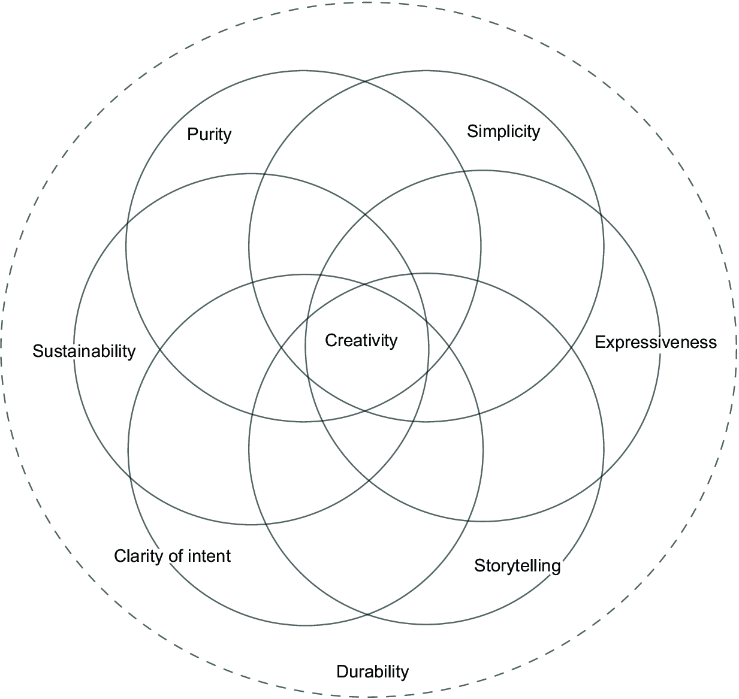
Creativity sits at the center of the rosette model, coordinating code qualities rather than replacing them. A solution becomes stronger when its qualities reinforce one another; pursuing one quality alone can make code harder to read or maintain. section 1.1
Constraints can stimulate creative thinking by narrowing attention to what is available. Performance, memory, readability, deadlines, and maintainability can produce more original and useful designs than unrestricted freedom, which can invite overengineering. Constraints must remain balanced: excessive limits can create stress and poor results. section 10.2
Practice by changing the constraints
Given a list of Person objects, produce one youngest name, one oldest name, and an alphabetical name list. First write the straightforward version. Then redesign it for maximum performance, minimal memory, and a single functional-programming pipeline. Compare the designs, then combine their best aspects into the clearest self-explanatory version. The exercise makes tradeoffs visible instead of treating one implementation as universally best. section 10.2.1
Use creativity as a repeatable problem-solving process:
- Clarify the problem by asking contextual questions and gathering data. For reproducible failures, trace backward from the first visible error; for nonreproducible failures, construct a timeline from the first report. section 10.4
- Investigate likely root causes with insight and outside input, evaluate hypotheses to identify the real cause, then implement and reflect so the solution becomes reusable knowledge. section 10.4
The practical aim is purposeful code, not novelty for its own sake. Treat limitations as design material, test competing approaches against the actual need, and preserve enough clarity that people can understand, trust, and safely evolve the result. section 10.4 section 1.3



