A service client can compose a system query by retrieving data from multiple services for a frontend view. This fits a frontend on the same LAN; a client outside the firewall may face a slower network. section 12.3.1
Choose where to place the API composer based on who uses the query and how complex its aggregation is:
- Use a service client for a frontend operating on the same LAN. section 12.3.1
- Use an API gateway when the query belongs to the external API; use a Backend-for-Frontend when it should be optimized for a specific frontend. section 12.3.1
- Use a composition service for queries shared internally by multiple services or for external queries with aggregation too complex for the gateway. section 12.3.1
Order Status view
A web application on the same LAN can retrieve order details through client-side composition. This is probably impractical for an outside client accessing services over a slower network. section 12.3.1
Figure 12.8 Four possible locations for an API Composer: client, API Gateway, Backend-for-frontend, or composition service
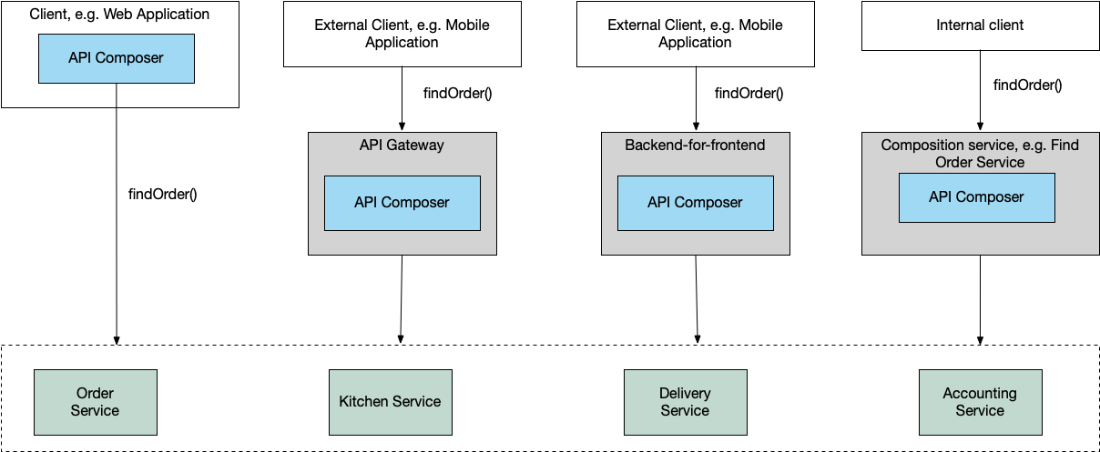
Compare the four possible locations for an API composer. section 12.3.1