A decoder is a neural-network component that receives compressed information from a bottleneck, decompresses it, and reconstructs the input or its encoded form for comparison with the original. section 9.4
Within an autoencoder, the decoder follows a constrained reconstruction workflow:
- Receive the bottleneck representation, which retains only the most important information. section 9.5
- Expand the compressed representation back toward the input dimensionality, commonly using a mirror image of the encoder architecture. section 9.5
- Produce an output with the same dimensionality as the input so reconstruction error can be measured. section 9.5
- Use binary cross-entropy for inputs in the [0,1] range and mean squared error otherwise. section 9.5
Figure 9.1 Structure of an autoencoder with an encoder, a bottleneck, and a decoder
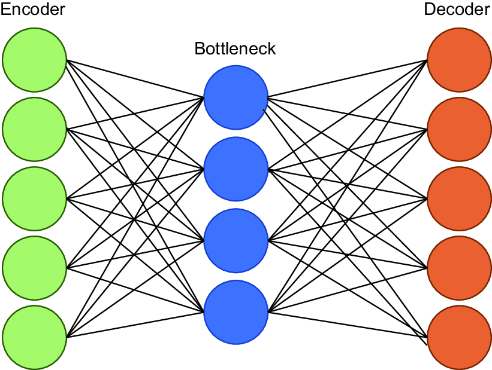
Shows the decoder’s position after the encoder and bottleneck in an autoencoder reconstruction pipeline. section 9.4




