A decoder is the part of an autoencoder that transforms a compressed representation back into an output resembling the original input. It follows the encoder, which progressively reduces the input to an embedding or latent representation. section 16.2.1
Decoder layers are typically arranged symmetrically with encoder layers. They expand the compressed representation and attempt to reconstruct the original data as closely as possible. Reconstruction error measures the difference between the input and this output. section 16.2.1
In an autoencoder, the decoder supports several practical steps:
- Receives the embedding produced by the encoder. section 16.2.1
- Expands that representation through successive neural-network layers. section 16.2.1
- Produces a reconstruction that can be compared with the original input. section 16.2.1
- Helps expose atypical records or images when reconstruction error is unusually high. section 16.2.1 section 16.4
Image reconstruction
For CIFAR10 images, a convolutional encoder compresses each 32 × 32 × 3 image and a decoder reconstructs it. A typical boat image is reconstructed closely; adding random noise produces a larger reconstruction error and flags the image as an outlier. section 16.4
Figure 16.2 Example of an AE. The neural network learns to condense any input to as many elements as appear in the middle layer and then reconstruct the data to its original values.
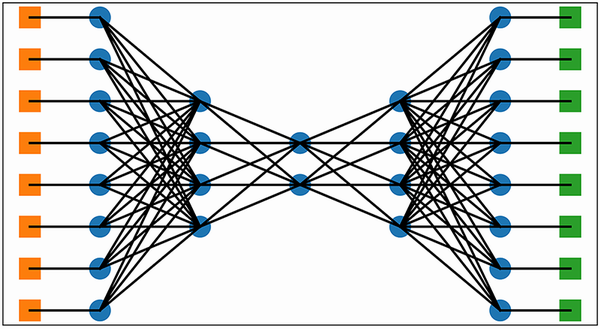
Diagram the encoder–decoder path from input through the compressed middle layer to reconstructed output. section 16.2.1




