Developer experience is the quality of developers’ day-to-day interactions with the tools, platforms, processes, and practices used to turn requirements into running software. In cloud native work, it matters because powerful technologies can also increase cognitive load, slow delivery, and reduce productivity. section 1.0 section 1.1.3
A useful focus is development infrastructure: how developers perceive and use tools, frameworks, platforms, and organizational processes. Slow tools, excessive learning demands, and unnecessary constraints can make the route from idea to value frustrating and less effective. Developer experience also includes work feelings and perceived value contribution, but improving the infrastructure dimension is the operational concern here. section 1.1.3
Treat developer experience as a workflow problem across the path to production:
- Start with a requirement, such as a feature, bug fix, refactoring task, or new application. section 1.5
- Improve the inner loop, where developers write, test, run, and debug code. section 1.5
- Improve the outer loop after a change reaches mainline, through deployment and production operation. section 1.5
- Use continuous delivery practices to make software delivery faster, safer, repeatable, and higher quality. section 1.5
Evaluate the experience by locating friction rather than prescribing one universal toolchain. Friction can appear throughout the software development lifecycle, and mitigation should fit a team’s context and skills. For platform engineers, this means treating developers as platform users; for organizations, reducing friction can improve productivity, compliance, quality, working conditions, and retention. section 1.3
Figure 1.5 Along the path to production, there are 10 main points that can cause friction and toil for developers.
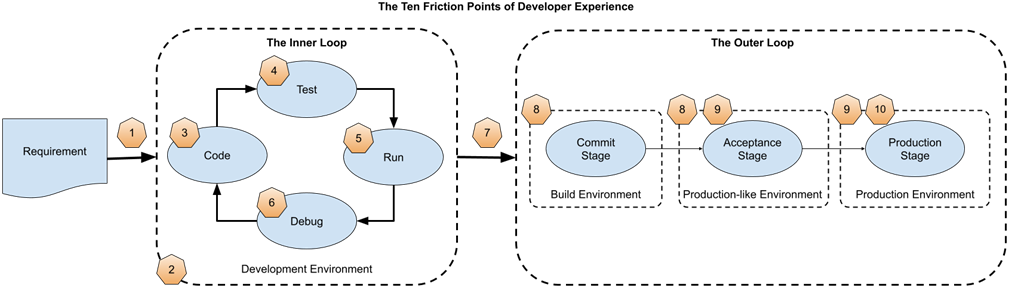
Use the friction-point map to inspect where toil appears along the path to production, then prioritize improvements in the workflows developers actually use. section 1.3
Following a feature from idea to production
A developer joining a healthcare application team receives a feature request for patients to book or manage appointments. The work moves through inner-loop development, integration, and production activities. Alternative tools and practices can be selected according to team constraints while addressing identified friction points. section 1.4 section 1.4.2








