DevOps is a culture of shared responsibility that brings software development and IT operations together. The developers who design, build, and test software also deploy, monitor, and support it; platform engineers likewise operate the capabilities they create. section 1.4.2
Effective DevOps practices reduce handoffs and delivery friction through:
- Cross-functional teams combining development, operations, QA, and security around common service goals. section 10.3.1
- Continuous integration and deployment pipelines that automate building, testing, and releasing software. section 10.3.1
- Regular collaboration and collective maintenance that improve communication, reduce misunderstandings, and resolve problems without unnecessary departmental escalation. section 10.3.1
Figure 1.1 Companies adopting a DevOps culture often start by enabling development teams to deploy their own infrastructure.
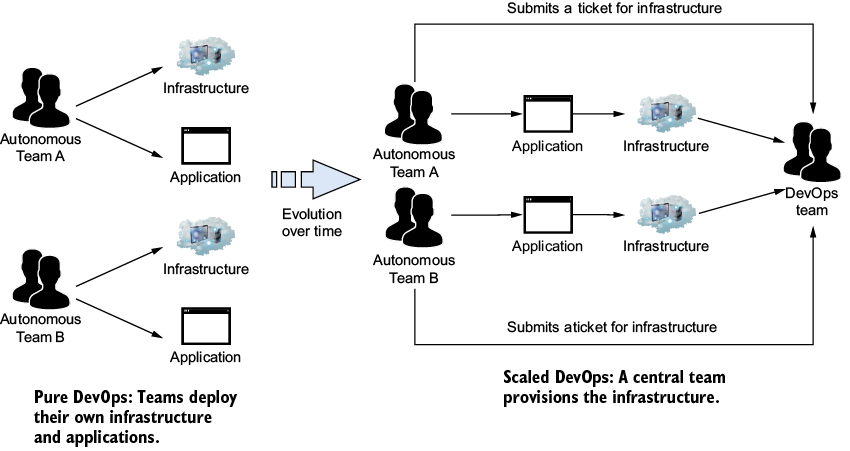
Use this figure to recognize the common failure mode where DevOps tools and infrastructure responsibilities move to development teams without comparable process or culture change, producing duplicated specialists and delivery bottlenecks. section 1.1
A practical cultural-shift exercise
Model the current delivery lifecycle with Visio, Lucidchart, or draw.io; map handoffs, bottlenecks, and feedback loops; then collect deployment frequency, lead time, and failure-rate data with Python or Bash and Jenkins, GitLab, or Jira APIs. Design a future-state process and prototype its CI/CD automation with a Jenkinsfile, GitLab CI/CD configuration, or GitHub Actions workflow. section 10.3.3






