DevOps bridges software development and operations through collaboration and automation. It reduces the mismatch between development assumptions and production reality while supporting rapid, adaptive delivery. section 1.3
A DevOps delivery approach emphasizes:
- Automating software development and delivery processes so teams can focus more on development as the project matures. section 1.3
- Reducing the cost and risk of late changes by improving information flow into project activities. section 1.3
- Organizing work through sprints, backlogs, end-of-sprint checklists, and accumulating documentation that supports production maintenance and governance. section 1.4
Sprint-based machine-learning delivery
Structure an ML project as successive sprints, record tasks in a backlog, verify completion with a checklist, and retain documentation for team reuse, production maintenance, and governance. A running Bike Shop case study connects these artifacts to project decisions. section 1.4
Figure 1.3 A generic DevOps production and delivery process (modeled after Ebert, 2016; redrawn and amended by the author)
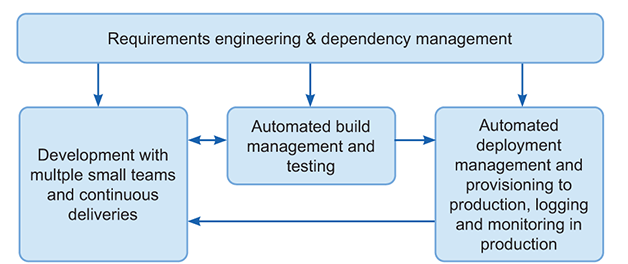
Use the generic DevOps production and delivery process to trace how automation and information flow support iterative software delivery. section 1.3






