DevOps keeps the environmental foundation of software delivery reliable: development, staging, and production resources, plus the systems that move applications toward deployment. In an LLM platform, this work includes hardware, clusters, networking, repositories, registries, databases, caches, and CI/CD pipelines. section 3.4
A practical boundary separates DevOps from neighboring disciplines. DevOps provides the infrastructure; DataOps manages data in motion and at rest; MLOps adds experiment tracking, model registries, and feature stores. Monitoring crosses all of these boundaries, while vector databases support LLM-specific workloads. section 3.4
Typical DevOps responsibilities include:
- Provisioning development, staging, and production environments. section 3.4
- Operating clusters, networking, source-control systems, artifact and container registries, databases, caches, and CI/CD pipelines. section 3.4
- Preparing infrastructure that can run LLMs confidently in production despite hardware and storage constraints. section 3.4
Figure 3.7 A high level view of an MLOps infrastructure with LLMs in mind. This diagram attempts to cover the full picture and the complexity of the many tools involved to make ML models work in production.
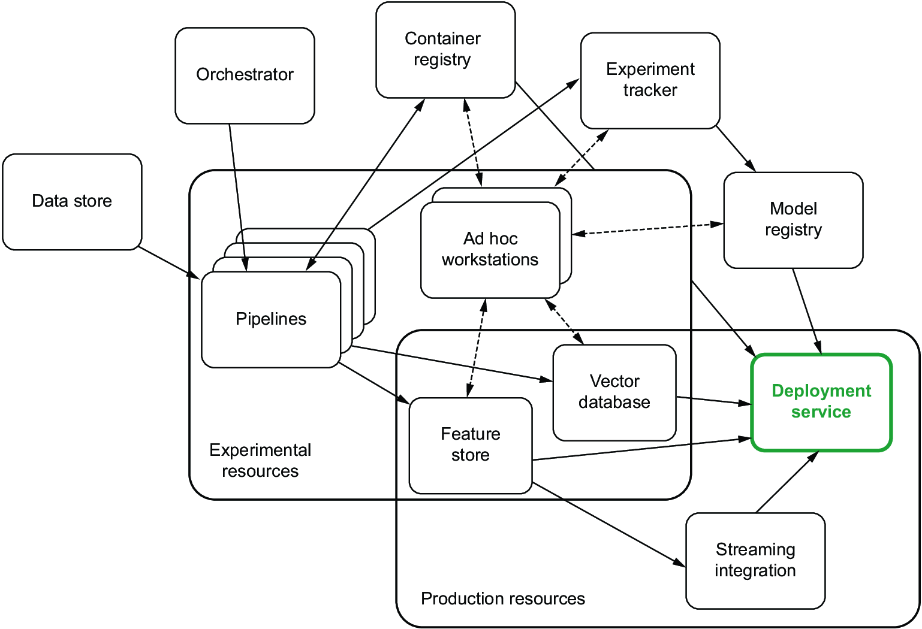
Use the infrastructure overview to trace how DevOps systems surround data, model, deployment, and monitoring components in an LLM platform. section 3.4






