A diffusion model is a generative model that creates realistic data from random noise by learning how to reverse progressive corruption. It is especially useful for complex, high-dimensional, continuous data such as images, speech, and video, when generation speed is less important than quality. In enterprise settings, diffusion supports generative design, creative content, image editing, and synthetic data creation. section 4.1 section 4.1.4 section 4.5
The core mechanism has two complementary processes:
- Forward diffusion gradually adds noise to an image's latent representation, corrupting it through a Markov chain whose next state depends only on the current state. section 4.1.4
- Reverse diffusion uses a neural network to predict and remove noise step by step until the corrupted representation resembles the desired output. section 4.1.4
- This approach can produce high-quality, varied outputs and avoids the mode-collapse problem associated with some GAN workflows, but iterative generation is slow. section 4.1.4
From random noise to a designed chair
A design team can use diffusion to generate novel chair concepts with target characteristics such as strength, aesthetics, material, and weight. The model begins with random noise and progressively removes it until a candidate design emerges; the team can then evaluate and refine the result. section 4.1 section 4.1.4
Figure 4.7 Stable Diffusion logical architecture
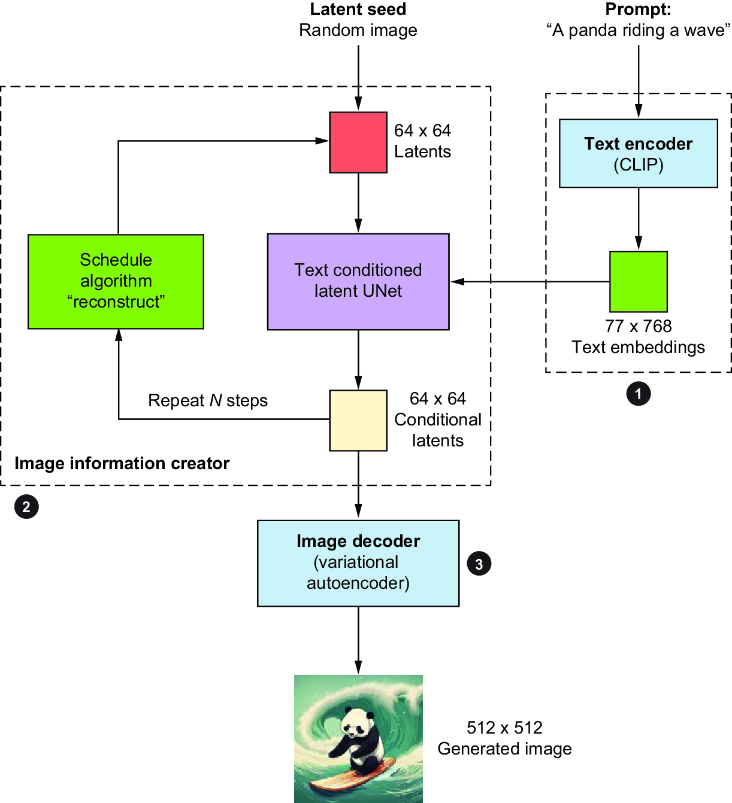
Use the Stable Diffusion logical architecture to inspect how a practical diffusion system organizes its components. section 4.1.4









