A diffusion model is a generative model that creates data by learning to reverse progressive noise added to examples. It is widely associated with synthetic images and videos, where it has largely replaced generative adversarial networks (GANs) in state-of-the-art applications. section 4.2
The central idea is intuitive: generation proceeds through gradual denoising, turning a noisy starting point into an image. This overview does not cover implementation details or training procedures. section 4.2
Figure 4.4 Image generation through gradual denoising in diffusion models
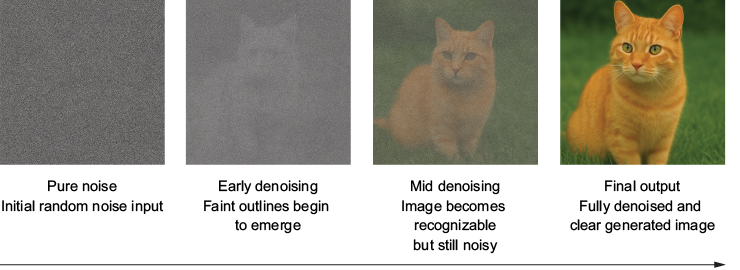
A figure traces image generation through gradual denoising, making the model’s basic mechanism easier to visualize. section 4.2
Diffusion models matter within a wider synthetic-media landscape:
- They belong alongside autoencoders and GANs as techniques for generating or altering images and videos. section 4.2
- Their outputs can expand creative access while contributing to privacy, trust, copyright, consent, and authenticity concerns surrounding synthetic media. section 4.15









