You can own 100% of an idea on Monday and a smaller slice of a real company after bringing in cofounders, employees, or investors. That reduction in percentage ownership is dilution. It happens when the company issues new shares: the total share count grows, while the shares you already hold represent less of the whole company. section 10.3 section 2.3
New shares are created for a financing round and sold for cash. Existing shareholders do not necessarily lose shares; their shares become a smaller percentage because there are more shares outstanding. A board resolution, with approval from a majority of existing shareholders, can authorize those new shares. section 3.1 section 20.2
A smaller percentage can still be worth more
Suppose you own 1,000 shares out of 1,000,000. The company issues 500,000 new shares to raise capital, while you keep your 1,000. Your ownership percentage falls because the total is now 1,500,000 shares. But if investors pay $2 per share rather than the earlier $1, the company valuation and the value of your stake can rise even as your percentage falls. The practical question is not just “How much am I diluted?” but “What is my holding worth after the round?” section 20.2.1 section 10.4
Treat dilution as a trade-off, not an automatic disaster:
- Accept dilution when new money gives the company the team, runway, or progress needed to create value; owning more of a company with no path forward is not necessarily better. section 10.3 section 3.1
- Watch the share price and valuation alongside ownership percentage. A valuation increase can outweigh a smaller ownership percentage by increasing the value of the shares you retain. section 10.4 section 20.2.1
- Be more concerned about flat or down rounds. Issuing additional shares at the same price creates pure dilution without a valuation uptick; a falling share price can leave a holder both more diluted and less valuable. section 10.6 section 20.2.1
- Include likely future financings when discussing employee options, because each financing can reduce the employee’s percentage ownership even when the company becomes more valuable. section 21.4.2
Figure 10.1 Pre- and post-money valuations for a sample seed and Series A. Values are in millions, except price per share.
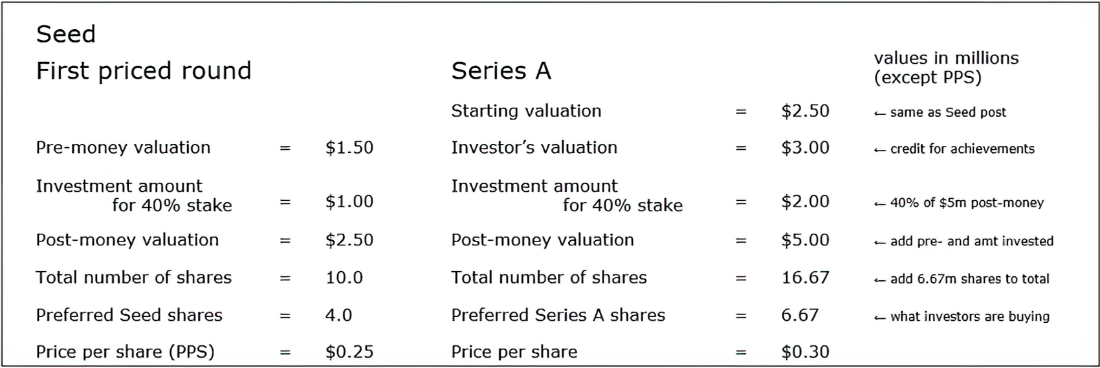
Compare pre-money and post-money ownership, valuation, and price per share across seed and Series A to see why percentage ownership and share value can move in different directions. section 10.4
The uncomfortable part is real: every priced equity round generally adds dilution. The useful habit is to evaluate the whole deal—cash raised, share price, valuation, and the company’s prospects—rather than fixating on the percentage alone. Dilution is most painful when the business is not gaining value; when it is, a smaller slice may still produce a larger eventual payout. section 20.2 section 20.2.1

