A distributed system is a set of independent networked computing devices that cooperate as one coherent system. Each device can run software independently and communicate with others, but users and application developers work through operations that address the collection rather than each machine separately. In robotics, one robot may contain several embedded computers, while a fleet coordinates multiple robot systems. section 4.2 section 2.2
Two servers do not automatically form a distributed system merely because a web backend uses a database. They become manageable as one when a shared layer can deploy and operate services without direct per-server interaction or even exposing how many servers exist. Middleware supplies that collection-level API while handling communication, composition, resource distribution, deployment, and analysis. section 4.2 section 4.8
Figure 4.2 Middleware distinguishes a distributed system from a mere collection of computational devices by managing network resources and providing a unified collection-level API for application developers.
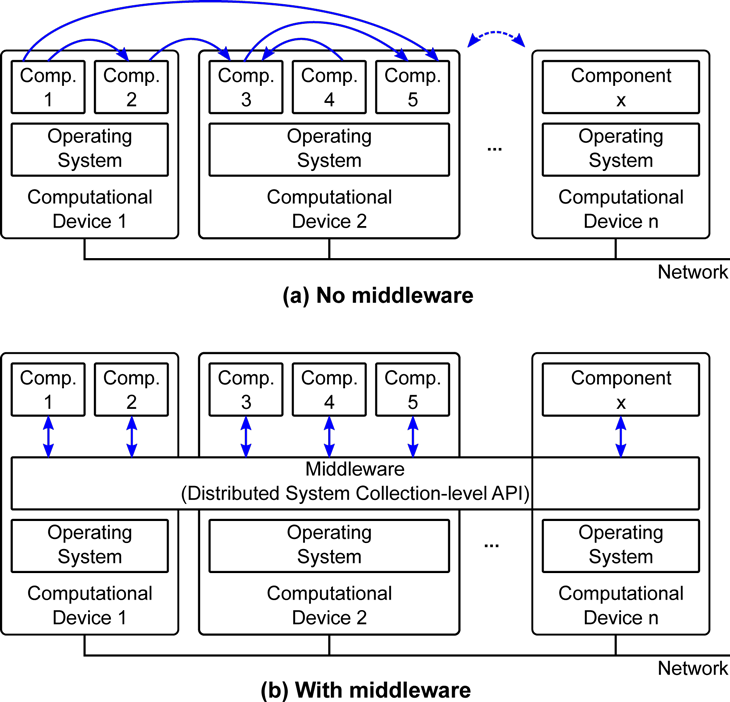
Middleware is the practical boundary between a collection of networked devices and a system that applications can address as one unit. section 4.2
Distribution is useful when robot components need flexible placement. An image-processing component can run across multiple compute devices or be integrated into one device; the software architecture can remain focused on the component’s role rather than its physical deployment. Publish-subscribe messaging similarly separates communicating components from one another’s network locations. section 4.2 section 4.8
Publishing detected objects
A perception component can publish an ObjectList on a detected_objects topic after packaging each object’s identifier and world pose. Another component subscribes to the same topic and receives the message through a callback. Publishers and subscribers need not know each other’s network locations; a topic may have multiple publishers and subscribers, with a defined message type. section 4.2
Figure 4.4 The publish-subscribe (pub-sub) communication pattern uses named logical channels called topics. These topics allow decoupled publishers and subscribers to exchange specific message types without knowing each other’s network locations. In general, each topic can have multiple publishers and multiple subscribers, and each topic can have a specific message type.
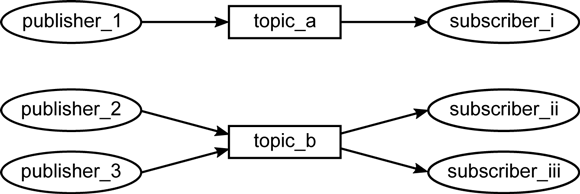
Topics provide named channels for typed messages, decoupling robot components even when their deployment changes. section 4.2
Key implications for robot software:
- Treat communication and deployment as system-level concerns, not just connections between individual machines. section 4.8
- Account for the fallacies of distributed computing when networked components cooperate. section 4.8
- Use real-time fieldbus protocols or industrial networks where networked components require real-time communication. section 4.8
- Expect distributed organization in many modern robots, particularly ROS-based robots. section 4.8