A distributed system is a collection of independent computing components that coordinate over a network to provide a unified service or computation. Unlike a single-threaded application on one machine, it cannot assume linear time, stable variables, or that a write is immediately returned by the next read. section 6.0
Distributed-system design is therefore the management of trade-offs among correctness, availability, speed, accuracy, and operational complexity. Database guarantees provide one starting point: ACID describes behavior within a single node or tightly coupled cluster, while distributed designs require additional models for coordination and consistency. section 6.0 section 6.2
The CAP theorem makes a central failure mode explicit:
- Consistency means each read receives the most recent write or an error; here, it means linearizability rather than an ACID consistency guarantee. section 6.2
- Availability means every request receives a non-error response, even when the response may contain outdated data. section 6.2
- Partition tolerance means continuing to operate correctly when communication between nodes is lost, delayed, or dropped. section 6.2
- During a partition, a CP system preserves consistency but may reject requests, whereas an AP system remains available but may return stale data. section 6.2
Because network instability is treated as inevitable, a CA design is not viable in practice when partitions must be tolerated. CAP is a decision aid for designing a system or selecting a database, not a promise that every desirable property can coexist. section 6.2
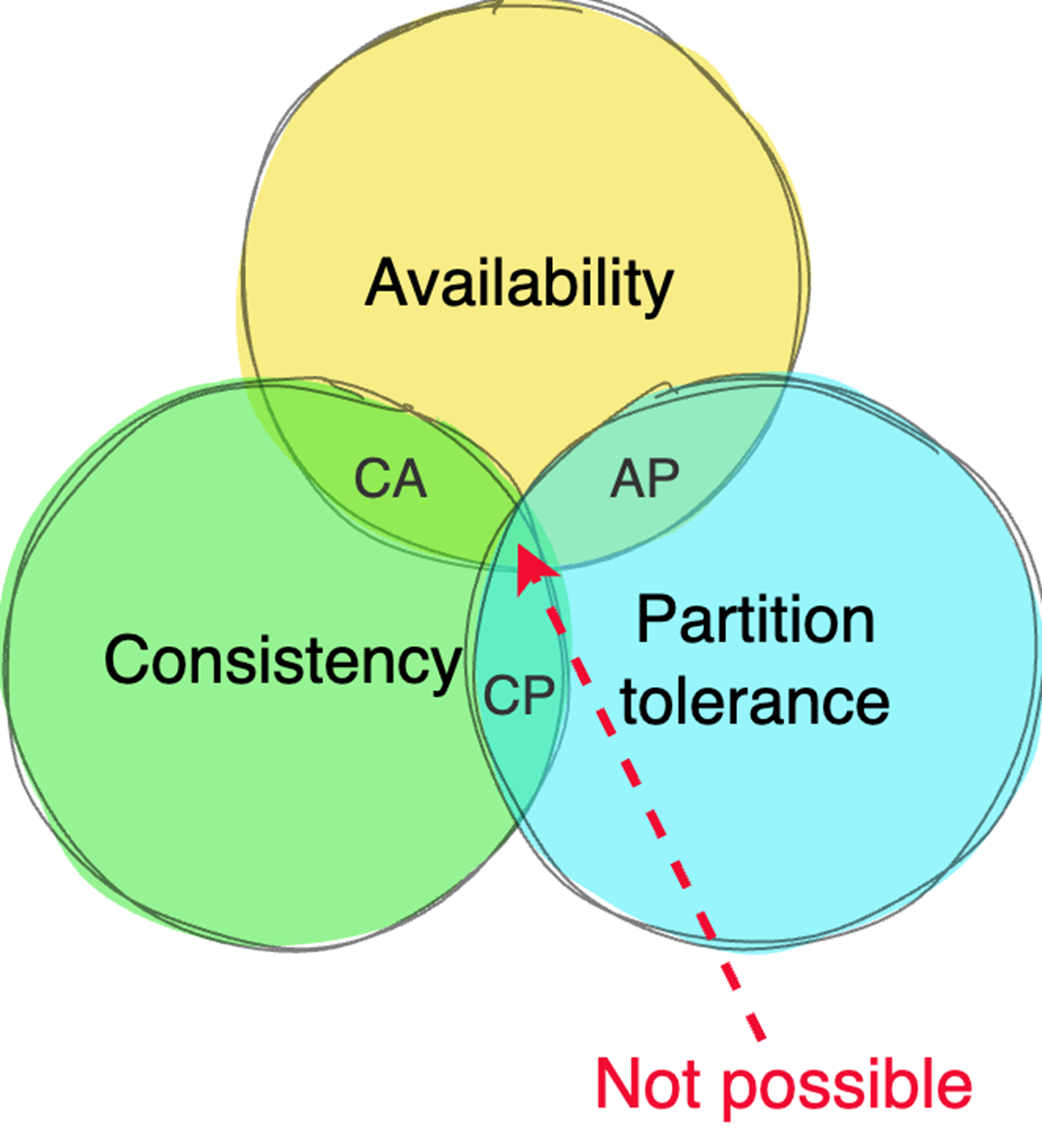
Use the figure to compare consistency, availability, and partition tolerance, then locate CP, AP, and CA choices. section 6.2