liveBook · Manning

Edge

As explained in Event Processing in Action

An edge is a connection between vertices in a graph, and in a directed graph it has an assigned direction.

An edge, also called a link, connects an output terminal to an input terminal in an event processing network. It represents the path along which event instances flow. section 6.1.1

One output terminal can have links to multiple inputs, distributing a copy of each emitted event along each link. Multiple links can also meet at one input; events arriving there are interleaved, with the ordering dependent on the implementation. section 6.1.1

Figure 6.1. An example event processing network, showing the graphical notation we are using, and illustrating some of the features of an EPN
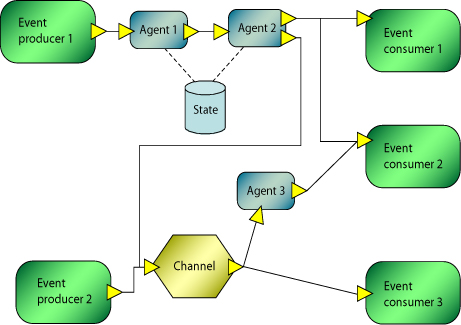
The network diagram shows links between processing elements and illustrates branching and multiple links to an input. section 6.1.1
How Event Processing in Action covers it

How deep it goes
Defines terminal connections and explains branching and merging, while leaving event ordering implementation-dependent.
Examples
Shows one agent sending event copies to two consumers and a consumer receiving events through multiple links.
What you can do after
Understand how links represent event flow, distribute copies, and bring interleaved events to an input.
How it connects
Connects graph edges to event processing networks, terminals, agents, producers, consumers, and channels.

Also explained in

Compare how 19 books explain edge →

Related concepts

This explainer was generated by Manning's knowledge graph from the text of Event Processing in Action. The section links point to the parts of the book it draws on.