The effect of treatment on the treated (ETT, also called ATT) asks a targeted counterfactual question: among units that received treatment, how different were their outcomes from what those same units would have experienced without treatment? For treatment T and outcome A, ETT is E(A_{+t} − A_{−t} | T = +t). Unlike the average treatment effect, it conditions the comparison on the actually treated population. section 10.7.1 section 10.7
This distinction matters when treatment assignment changes between an experiment and production. For example, a recommendation policy may appear effective under random assignment, yet be assigned in production mainly to highly engaged subscribers who would remain subscribed either way. ETT evaluates the policy for that exposed group rather than for an experiment-wide population. section 10.7.1
For binary outcomes, write the estimand as:
- P(A_{+t}=+a | T=+t) − P(A_{−t}=+a | T=+t). Consistency reduces the first term to the observed probability P(A=+a | T=+t); identification focuses on the unobserved counterfactual term. section 10.7.1
- With a suitable confounder C, SWIG reasoning yields Σc P(A=+a | C=c, T=−t)P(C=c | T=+t): estimate untreated outcomes within confounder strata, then reweight them to the treated population. section 10.7.4
Figure 10.23 We can use the SWIG to derive ETT using the ignorability trick.
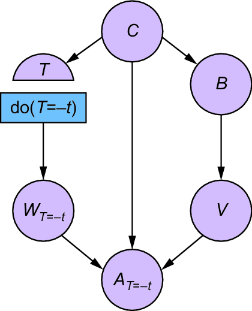
Use the SWIG diagram to trace how node splitting and d-separation replace the treated-policy condition with the untreated-policy condition within confounder strata. section 10.7.4
From identification to probabilistic inference
A causal generative model can estimate an identified ETT without separately fitting every component of its estimand: train the model on data, apply do(E=0) to impose low engagement, condition on observed E=1 to select highly engaged units, and run inference. Pyro-style condition and do operations produce samples for comparing the counterfactual outcome distributions. section 10.8
ETT is not assumption-free. Graphical identification can establish it for the binary-outcome case described here; nonbinary outcomes require additional level-3 assumptions. SWIGs provide an intuitive route under the single-world assumption, while counterfactual graphs and identification algorithms handle broader queries. section 10.7.1 section 10.10

