A treatment effect answers a change question: how would an outcome differ if the treatment changed while the relevant causal context stayed fixed? It is not the same as an observed association. People who receive a treatment may differ from those who do not for reasons that also affect the outcome, so correlation alone can confuse coincidence with cause. section 1.0 section 1.4.2
The treatment, also called a decision variable, is the variable whose effect is sought; the outcome is the result of interest. The average treatment effect (ATE) summarizes the causal effect of one variable on another. A causal model makes the assumed relationships explicit, often with a directed acyclic graph (DAG), so potential confounders and mediators can be considered rather than ignored. section 1.4.2 section 1.8 section 1.1.3
Medication and recovery
Suppose a doctor wants to know whether a new medication improves recovery. Age affects both which medication a patient receives and how quickly the patient recovers. Comparing raw recovery rates can therefore mix the medication’s effect with age-related differences. Age is a confounder: it creates a misleading path between treatment and outcome unless the analysis accounts for it. section 1.4.2
Figure 1.6 Apart from how treatment may affect recovery, there’s a third element affecting both simultaneously. These elements are called confounders. For instance, in this example, age is a confounder.
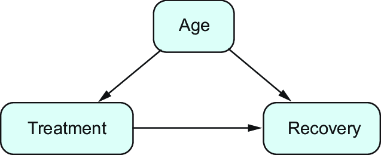
Use the diagram to separate the treatment-to-recovery relationship from age, which influences both treatment choice and recovery. section 1.4.2
When treatment is binary, one causal contrast asks for the difference between the expected outcome after setting treatment to 1 and the expected outcome after setting it to 0: E[Y|do(D = 1)] − E[Y|do(D = 0)]. For a continuous treatment, a linear-model coefficient can represent the outcome change from a one-unit treatment increase while other included variables remain unchanged. That interpretation requires the causal assumptions behind the model, not merely a fitted regression. section 9.2.1 section 6.0
Estimating a treatment effect depends on what the data and causal model support:
- Adjust for observed confounders with the adjustment formula; in linear models, this corresponds to controlling for confounders in regression. section 1.1.5 section 9.2.1
- Use an instrumental variable when treatment–outcome confounders are unobserved but an instrument supplies independent treatment variation under additional assumptions. section 9.2 section 9.2.1
- Use time-related approaches such as differences in differences, regression discontinuity, or synthetic controls when an experiment is impractical and their assumptions fit the setting. section 1.1.5 section 11.0
Release effect as a counterfactual gap
To estimate whether releasing a new movie increased interest in an older one, train a model before release using an unaffected, correlated comparison series. Its post-release predictions represent the estimated without-release outcome. The gap between actual interest and those predictions estimates the release’s treatment effect, provided the comparison series remains unaffected and the method’s assumptions are credible. section 11.3 section 11.0
Randomized experiments, including A/B tests, are preferred when feasible because random assignment eliminates confounding. When they are not feasible, state the causal goal and assumptions, check whether important confounders are missing, and consider new data or surrogate variables. A useful estimate is one whose model complexity and assumptions are appropriate for the decision at stake. section 1.8 section 1.1.4 section 1.1.5
