Kafka data can be exposed while crossing a network or while stored on disk. Encryption helps protect it in both states; highly sensitive data may need end-to-end encryption as well. section 13.2 section 13.4
Choose protections according to where data is vulnerable:
- Encrypt network traffic and sign it to protect data in transit and its integrity. section 13.2
- Encrypt disks through the underlying storage system; Kafka does not provide native at-rest encryption. section 13.4
- Use client-level end-to-end encryption for highly sensitive data. Network and disk encryption do not protect data from server or Kafka administrators. section 13.2
For ZooKeeper-based clusters, unencrypted connections can expose Kafka metadata and, in some cases, stored credentials. TLS is supported for ZooKeeper connections with Kafka 2.5 and later; mutual TLS is recommended between brokers and ZooKeeper. Watch latency, since excessive delay can affect cluster availability. section 13.2.6
Figure 13.3 Securing a Kafka cluster involves transport encryption for communication, user authentication and authorization, and encryption of data at rest.
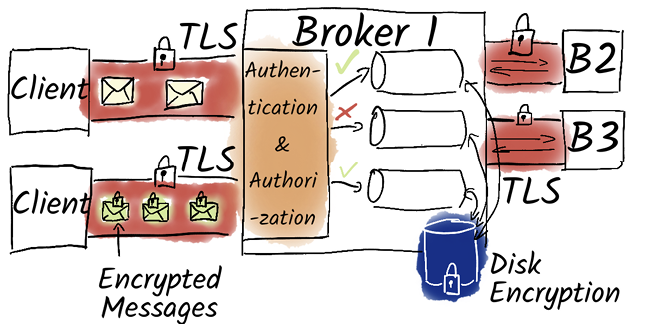
The diagram connects transport encryption, authentication and authorization, and encryption at rest as complementary Kafka security measures. section 13.2















