Encryption transforms readable data into an encoded form that unauthorized people cannot usefully read. It matters whenever data crosses an untrusted network, enters cloud services, or contains personal information governed by confidentiality requirements. section 5.0 section 10.2.1
Without encryption, intercepted traffic remains plain text: an attacker positioned between a device and server can read passwords and other messages. TLS encrypts the connection and also helps detect tampering and verify the server’s identity. section 10.2.1 section 10.5
Common encryption choices serve different boundaries and responsibilities:
- AES protects data confidentiality and, with Galois/Counter Mode, can provide confidentiality, integrity, and authenticity. section 5.0
- RSA uses a public key for encryption and a private key for decryption; the private key can also sign data for public-key verification. section 6.4
- ECC can implement public-key encryption and decryption with a selected curve; the Java example uses the Bouncy Castle provider. section 7.2.1
- TLS applies encryption to communication between endpoints, commonly terminating at an ingress layer or, in special cases, inside the application. section 10.4
Encrypting a service-to-service refund file
A warehouse service encrypts refunds.json with the recipient’s RSA public key and writes refunds.json.rsa. The payments service uses the matching private key to decrypt it. The sender can additionally sign the data with its private key, allowing the recipient to verify the signature before decryption. section 6.4
Figure 10.10 With TLS enabled, intercepted messages are encrypted and unreadable by attackers. Even if someone tries to alter the message, the recipient will detect the tampering because the digital signature won’t match the sender’s certificate. This is how TLS ensures both confidentiality and integrity.
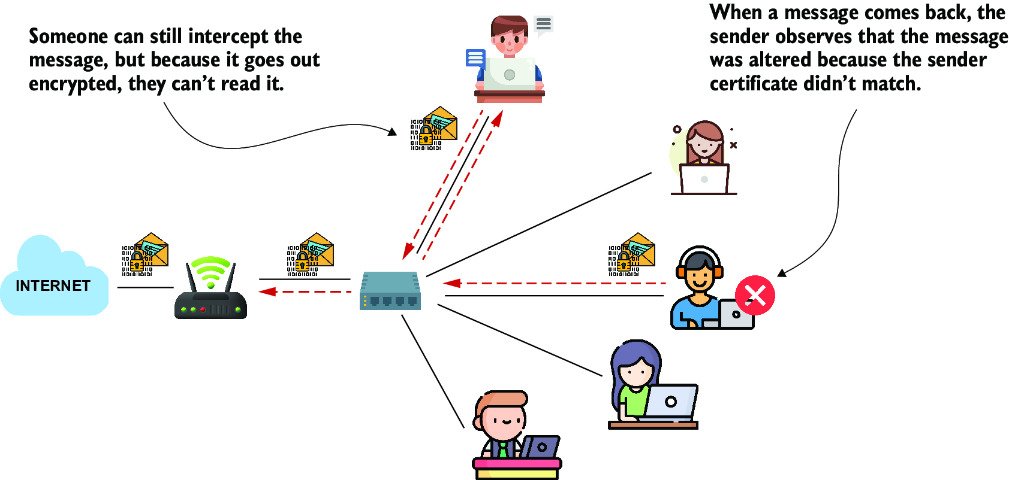
Use the diagram to see how TLS makes intercepted messages unreadable and exposes alteration through signature verification. section 10.2.1
















