A robot’s environment is the specific part of the real world with which it currently interacts. It is both the input context and the result of robot activity: sensors observe it, planning uses its state, and actuators alter it. The environment therefore closes the robot system’s continuous loop. section 1.2.1 section 1.5
Treat the environment as part of a six-part feedback loop:
- Sensors acquire raw information from the environment. section 1.2
- Sensing converts that data into meaningful state information. section 1.2
- Planning derives an action from the current robot and environment state. section 1.5
- Acting and actuators execute commands that change the robot and its environment. section 1.5
A changing loop
A minimal loop is: while True: state = sense() action = plan(state) act(action) A mobile robot that rotates its wheels moves before the next iteration. The environment can also change independently: an unsupported object may fall, or people and other machines may alter the shared space. Consequently, identical actions need not produce identical results. section 1.2.1
Figure 1.1 The conceptual structure of a robot system forms a continuous loop across six essential parts. Sensors acquire raw data from the environment, which sensing processes into meaningful information. Planning uses this information to calculate the next action, which acting translates into physical commands for actuators that ultimately alter the environment.
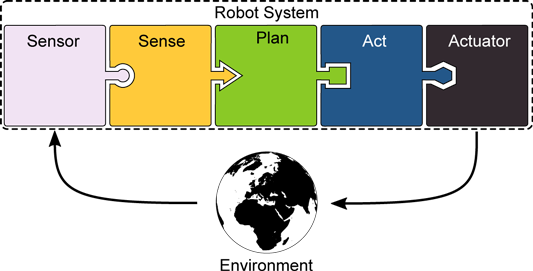
Trace how environmental changes travel through sensing, planning, acting, and actuation before returning to the environment. section 1.2
Environment definition is also an engineering decision. Stating the robot’s purpose together with a specific, restrictive operating environment can make the system simpler, more reliable, and more cost-effective. That choice influences robot architecture, sensor selection, actuator selection, and planning. section 1.3









