Model evaluation assesses and compares predictions, analyzes errors, and guides iteration across a machine-learning workflow. In ligand-based screening, evaluation connects molecular features and labels with performance on data the model has not seen. section 3.0
A useful evaluation practice includes:
- Separate training and test data before fitting the model, then judge generalization on the held-out test set rather than relying on training performance. section 3.3.2 section 3.5
- Compare metrics derived from confusion matrices instead of treating a single score as sufficient. section 3.5
- Use cross-validation to make efficient use of available training data, and revisit preprocessing, featurization, or training choices when performance is inadequate. section 3.0 section 3.5
Evaluating a hERG blocker classifier
A stochastic-gradient-descent classifier learns from molecular fingerprints after a train/test split. It predicts training labels and achieves 0.964 accuracy, but that result alone does not establish success: evaluation must address overfitting and performance on unseen molecules.
Figure 3.1 Key stages in our ML workflow.
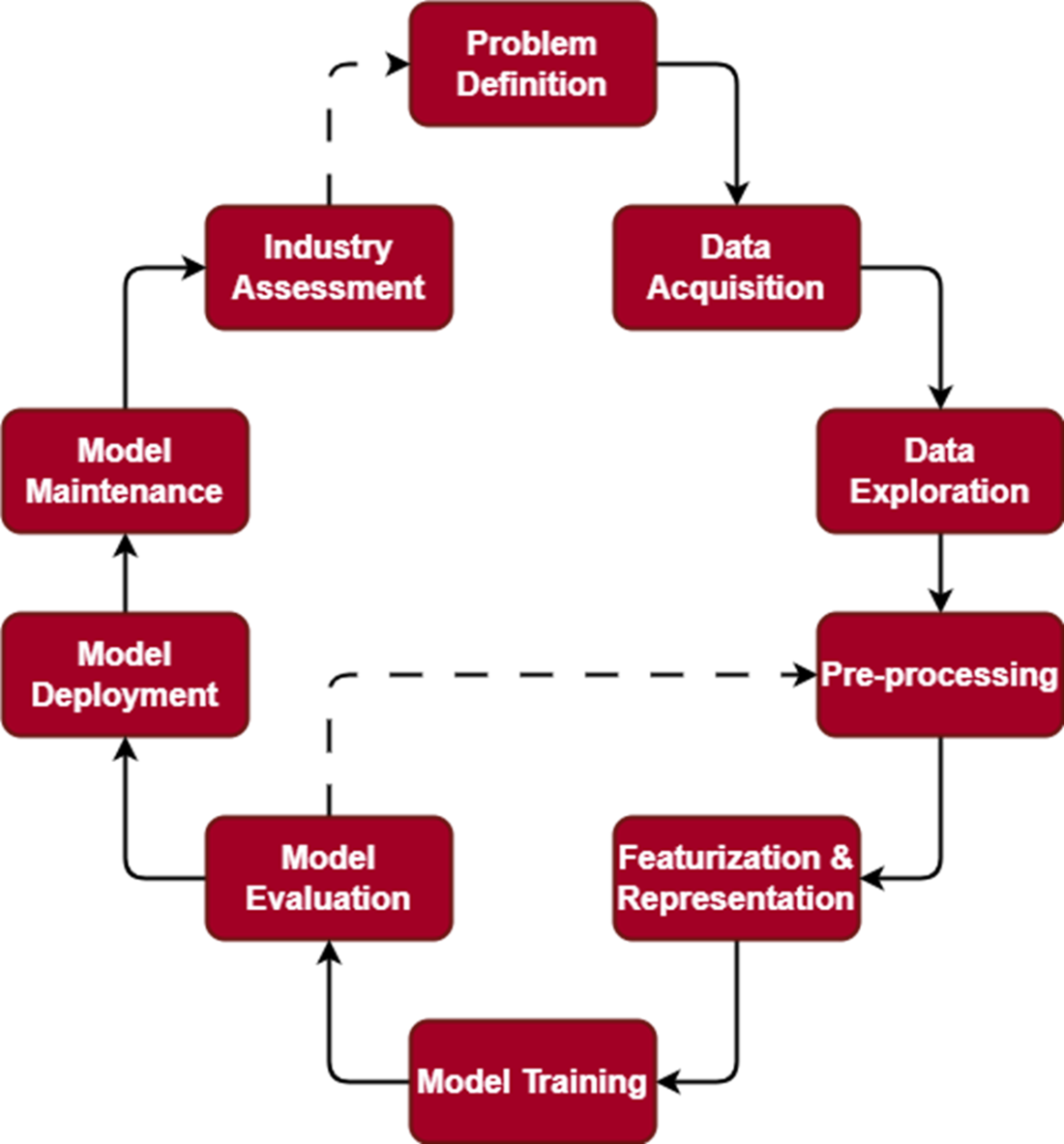
Use the workflow diagram to trace how evaluation feeds decisions about data preparation, featurization, training, deployment, and maintenance. section 3.0




























