Evaluation checks whether a model predicts well on unseen data by comparing its predictions with actual values. In AI-assisted development, verification also limits the trust deficit that arises when code production outpaces review capacity. section 4.5.3 section 8.1.1
Price-prediction evaluation uses three metrics to assess different kinds of error:
- R² measures how much variation in actual prices the model explains. section 4.5.4
- MAE reports the average absolute error in the target’s currency. section 4.5.4
- RMSE penalizes large errors more heavily than MAE. section 4.5.4
Price-prediction evaluation
A trained model predicts prices for the test features; evaluation compares those predictions with the test labels and calculates R², MAE, and RMSE. section 4.5.3 section 4.5.4
Figure 4.6 The full prediction of the price ML pipeline.
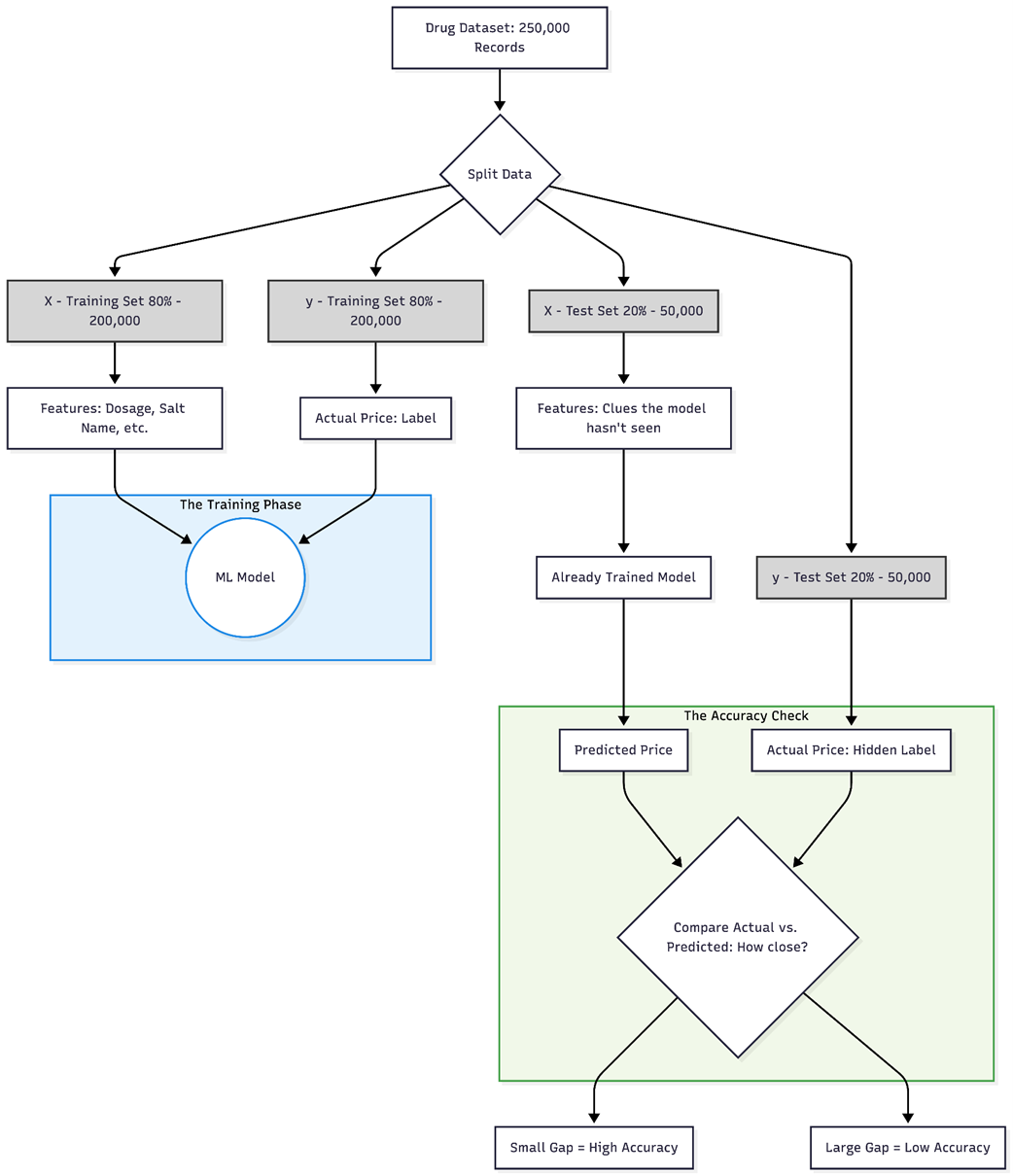
Trace the training and test-set flow from model fitting to prediction and accuracy calculation. section 4.5.3
When code generation accelerates, review capacity may not keep pace. Reviewing faster can mean catching fewer bugs; trusting generated code more transfers the risk to production rather than removing it. section 8.1.1




























