A dimension is one independent attribute, or dataset column, needed to describe a data point. A dataset with five columns therefore has five dimensions. section 2.12
Think of dimensions as coordinates that locate each data point:
- One dimension places points on a line, like houses identified by one number. section 2.12
- Two dimensions place points in a city-like grid, using two numbers such as street and avenue. section 2.12
- More dimensions add coordinates, even when the resulting space is difficult to picture. section 2.12
Housing and language data
A housing dataset might use size, bedrooms, bathrooms, crime rate, and school distance as five dimensions. A sentence represented by counts of aack, beep, and crack becomes a point such as (5, 8, 3), with three dimensions. section 2.12 section 5.9
Figure 2.8 How to imagine higher dimensional spaces: One dimension is like a street, in which each house only has one number. Two dimensions is like a flat city, in which each address has two numbers, a street and an avenue. Three dimensions is like a city with buildings, in which each address has three numbers: a street, an avenue, and a floor. Four dimensions is like an imaginary place in which each address has four numbers. We can imagine higher dimensions as another imaginary city in which addresses have as many coordinates as we need.
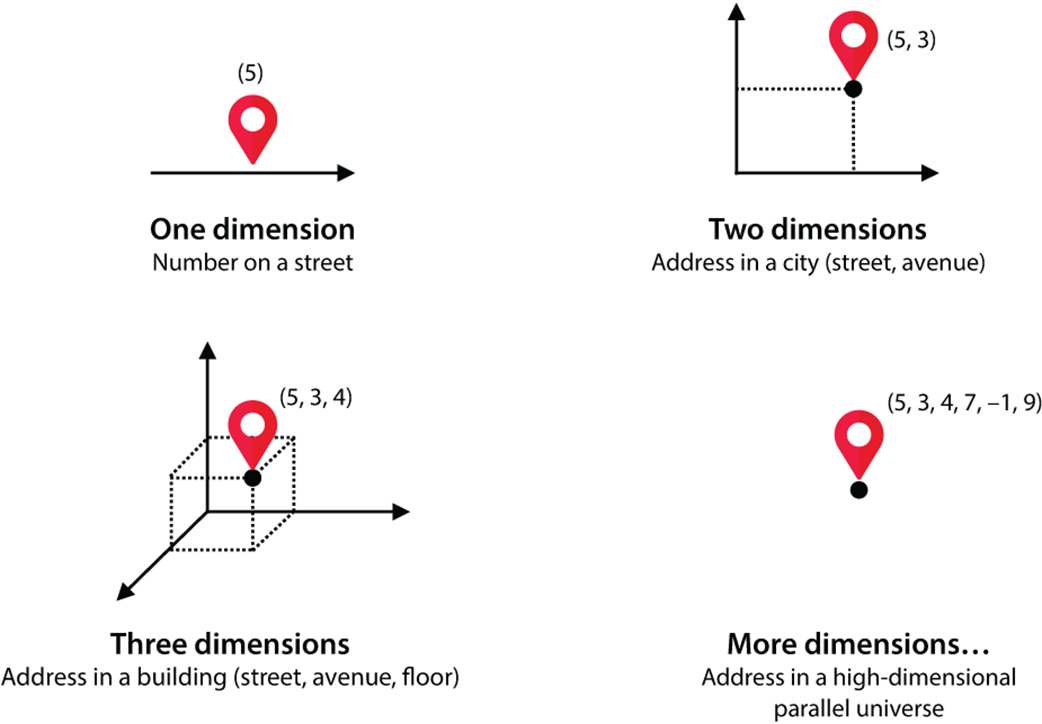
Use the address analogy to visualize one, two, three, and higher-dimensional data as points identified by increasing numbers of coordinates. section 2.12