In robotics, dimension is the minimum number of independent coordinates needed to specify a point’s position in a space. A 1D space needs one coordinate, a 2D space uses (x, y), and a 3D space uses (x, y, z). Dimension describes position only; orientation belongs to an object’s pose. section 6.1.1
Keep these related quantities separate:
- Dimension counts independent position coordinates in the space. section 6.1.1
- Pose parameters count independent values for both position and orientation. section 6.1.1
- A coordinate system provides numerical values that uniquely determine an object’s pose within that space. section 6.3
Robot geometry in practice
A planar robot can represent a point as (4, 2), while a spatial point can use (5, 2, 0). A complex three-dimensional SnackBot model can be abstracted into a 2D model of rectangular links and rotary joints when analyzing planar motion. section 6.1.1
Figure 6.2 Spaces with 1D, 2D, and 3D dimensions require varying numbers of pose parameters (PP) to fully define an object’s position and orientation, with up to 6 PP needed for a 3D object in 3D space.
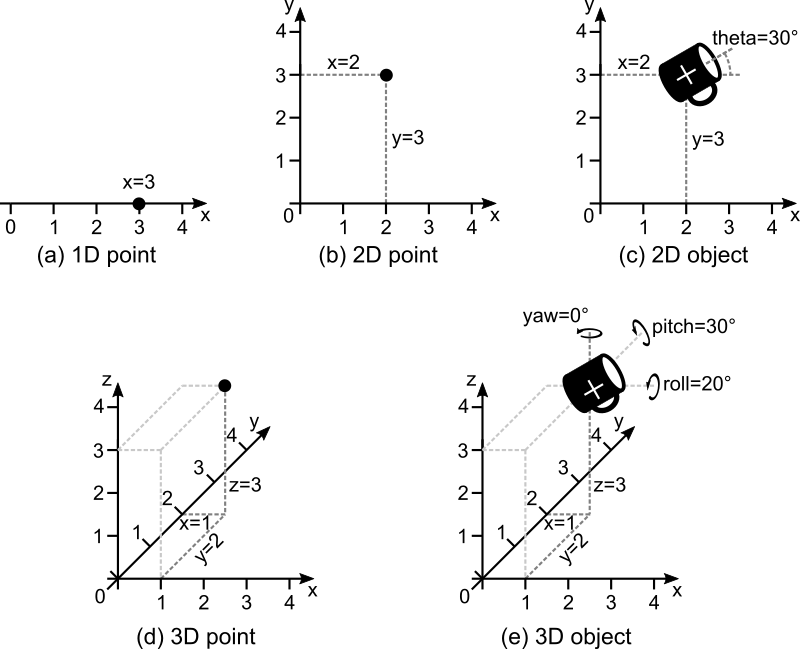
Compare 1D, 2D, and 3D spaces with the pose parameters needed to fully specify an object. section 6.1.1