Feature selection chooses a subset of input features that are useful for a machine-learning task. Removing irrelevant or noisy features can reduce spurious correlations and overfitting without changing the information originally present in the useful data. section 5.1.1
Filtering noisy MNIST features
Create normalized MNIST images, append either random-noise channels or all-zero channels, and train the same dense classifier on each version. Compare validation accuracy across ten epochs. The noise-channel model performs worse because the added features encourage spurious correlations; the zero channels do not add information. In R/Keras, the workflow uses array_reshape(), cbind(), keras_model_sequential(), fit(), and validation metrics. section 5.1.1
A practical feature-selection workflow is:
- Compute a usefulness score for every available feature, such as mutual information between the feature and labels. section 5.1.1
- Keep features above a chosen threshold, then train the model on the reduced dataset. section 5.1.1
- Use selection alongside feature engineering when building a small model intended to beat a simple baseline. section 6.2.3
Figure 5.6 Effect of noise channels on validation accuracy
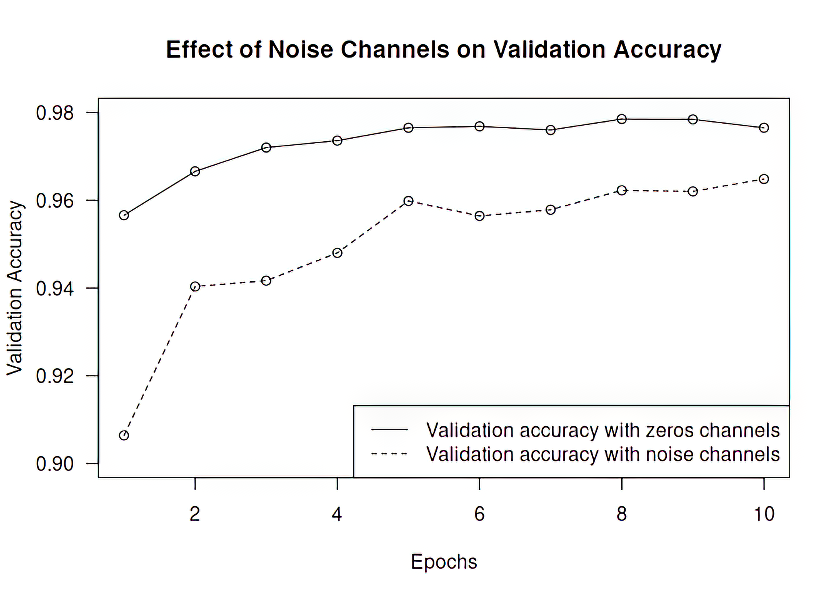
Compare validation-accuracy curves to see how adding noisy features affects generalization. section 5.1.1







