Feature selection narrows a dataset to the inputs most useful for modeling. Removing irrelevant or redundant features can reduce training costs, improve interpretability, limit false signals, and sometimes improve test performance. section 2.2.3 section 6.2
A practical workflow can combine domain judgment, simple tests, and model-based checks:
- First rule out features that have no plausible relationship with the target or fail simple univariate checks such as correlation or chi-square analysis. section 2.2.3
- Then shuffle each feature and measure whether model performance changes; features whose randomization has little effect may be irrelevant or redundant. section 2.2.3
- Prioritize explicit selection for algorithms such as linear models, which use every supplied feature and can be misled by noisy inputs. section 6.2
- Treat selection as optional for tree ensembles, which can automatically ignore some irrelevant or redundant features, while still considering its benefits. section 6.2
Feature sampling inside a random forest
Random forests use a related but different form of selection: at every decision-tree split, they sample a set of features as candidate split variables. Together with bootstrapped training examples, this creates diverse trees with less-correlated predictions, which can improve the reliability and accuracy of majority-vote results. section 5.1.2
Figure 5.4 How random forests arrives at its results by combining the different data partitioning due to its decision trees thanks to majority voting
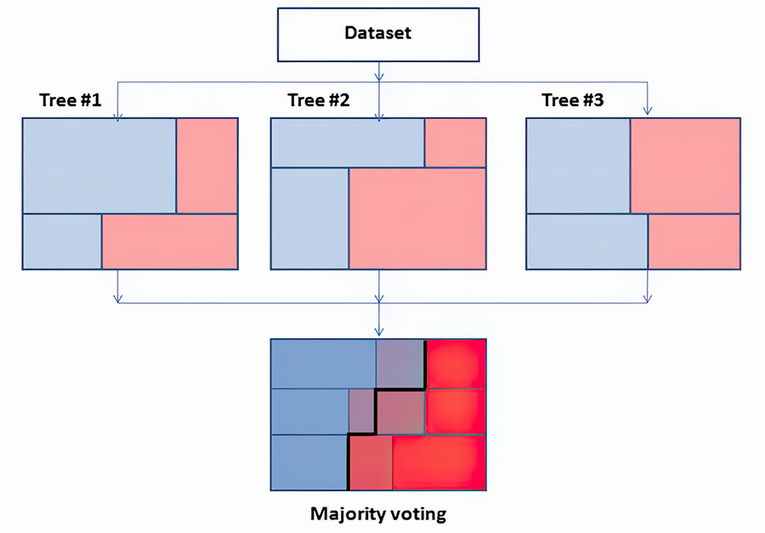
Use the random-forest diagram to compare the diverse partitions produced by sampled features with the final majority-vote prediction. section 5.1.2







