Feature selection chooses the subset of input features most useful for a specified analysis or prediction task. In outlier detection, it is especially important because unsupervised detectors treat all features equally and cannot learn relevance from a target column. section 4.7
Select features by asking whether unusual values or combinations would matter:
- Remove irrelevant features to reduce noise, mitigate the curse of dimensionality, and improve detector efficiency. section 4.7
- Check each feature independently and in combinations, since a column may be uninteresting alone but useful for detecting relationships. section 4.7
- Treat selection as part of an iterative workflow alongside preprocessing, model fitting, evaluation, and tuning. section 4.1
Staff records
A staff table can retain Staff ID and Start Date when unusual values might reveal data errors or fraud. Test IDs for reasonable ranges or duplicates, then compare Staff ID and Start Date rankings to find inconsistencies. section 4.7
Figure 4.1 Workflow outlining the basic steps in an outlier detection project. This assumes a one-time analysis (as opposed to ongoing monitoring) and skips tests for collective outliers and time-series analysis, which may also often be done. Note the loop between tuning and evaluating the model, which may continue for any number of iterations. Additional loops may also be present in some projects, as any of the steps may be repeated as necessary.
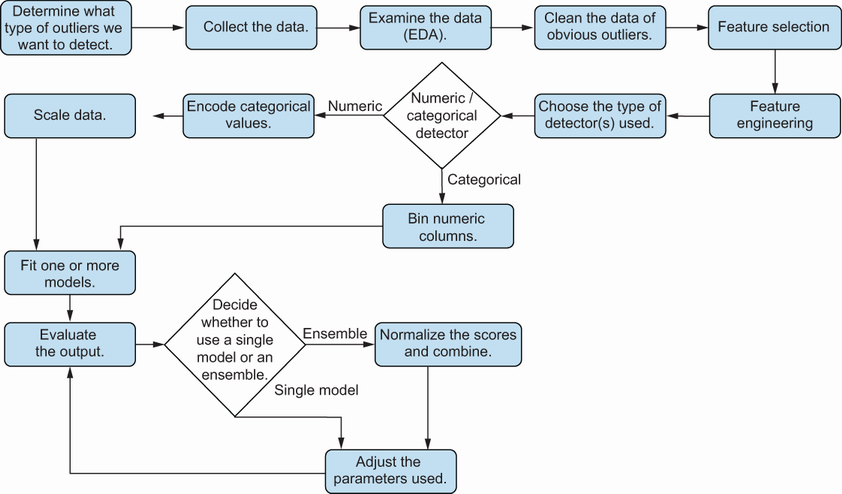
Use the workflow to place feature selection between data cleaning and feature engineering, while revisiting choices during model evaluation and tuning. section 4.1







