Graph machine learning applies machine learning to graphs: structured data whose nodes, edges, and features encode relationships. It builds representations that support node prediction, link prediction, graph classification, visualization, clustering, and other analysis tasks. section 1.2 section 1.2.3
A practical graph-learning workflow typically follows these steps:
- Represent entities as nodes, relationships as edges, and available attributes as graph features. section 1.2 section 8.0
- Convert raw or nongraph data into edge lists, adjacency lists, and model-ready graph data. section 8.0
- Create node, edge, or whole-graph embeddings as lower-dimensional representations that preserve useful patterns and relationships. section 1.2.3 section 2.0
- Train a suitable method for the target task, including classical algorithms, matrix methods, or graph neural networks. section 1.2.3 section 2.0
Graph neural networks are one graph-learning approach. They combine neural networks with graph data, transform nodes or edges into nonlinear embeddings through message passing, and learn representations during training. Their permutation invariance makes predictions independent of node ordering or adjacency-matrix arrangement, while their design is less suited to images and tables. section 1.2.4
Recruiting-firm social graph
A recruiting firm can model job candidates as nodes and relationships between candidates as edges. Candidate IDs, job types, and industries become node data; raw files are transformed into graph structures and prepared with NetworkX and PyTorch Geometric for GNN training. section 8.0
Figure 1.7 An overview of how GNNs work. An input graph is passed to a GNN. The GNN then uses neural networks to transform graph features such as nodes or edges into nonlinear embeddings through a process known as message passing. These embeddings are then tuned to specific unknown properties using training data. After the GNN is trained, it can predict unknown features of a graph.
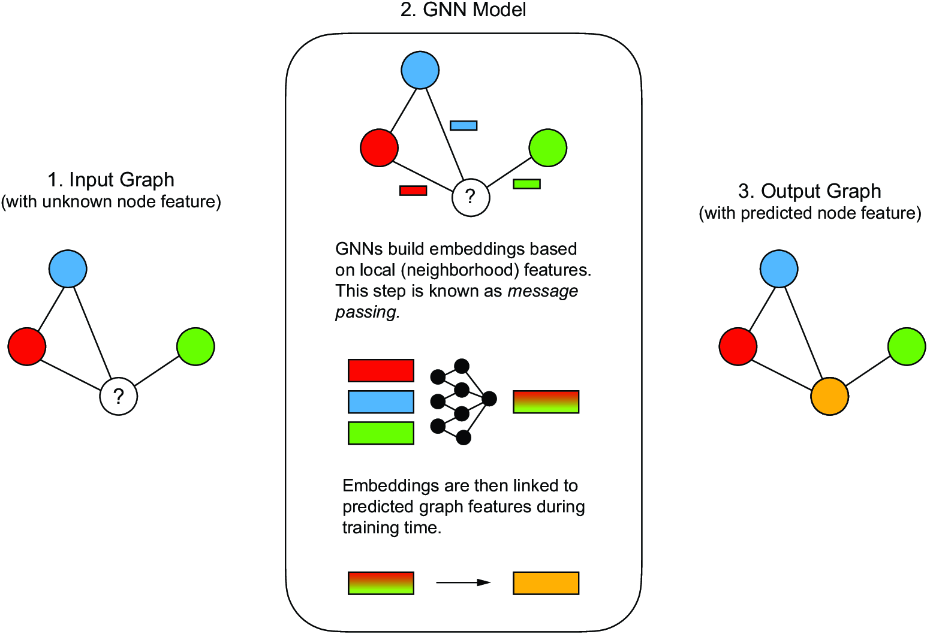
Follow the pipeline from an input graph through message passing and learned embeddings to predictions of unknown graph features. section 1.2.4


