liveBook · Manning

Function

As explained in Deep Learning with PyTorch, Second Edition

A mathematical mapping from inputs to outputs, used here as the target of approximation by learning systems.

A function maps inputs to outputs. In machine learning, a model is a function with unknown parameters whose values are estimated from data, allowing it to approximate patterns rather than solve only one fixed task. section 5.1

From an ellipse to a general model

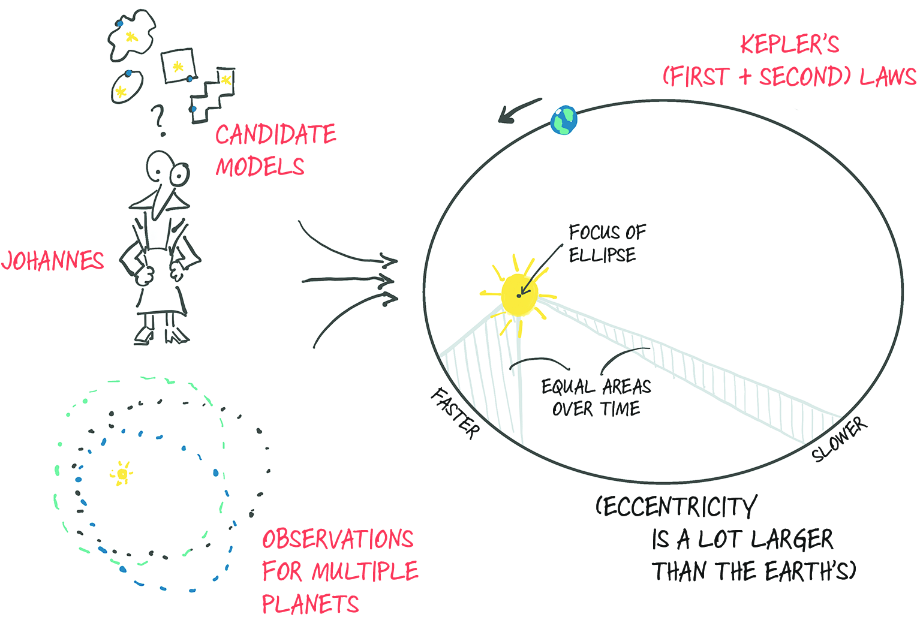
Kepler tested candidate models against observations and settled on an ellipse. A neural network could instead approximate a wider family of functions from input-output pairs, adapting to the task through learned parameters. section 5.1

Figure 5.1 Johannes Kepler considers multiple candidate models that might fit the data at hand, settling on an ellipse.
figure

Compare candidate models fitted to observations, including the ellipse selected as a useful model. section 5.1


How Deep Learning with PyTorch, Second Edition covers it

How deep it goes
Defines functions through models and parameters, but defers derivative mechanics to later treatment.
Examples
Uses Kepler’s ellipse, observed trajectories, and neural networks as contrasting function-fitting examples.
What you can do after
Understand how learning systems approximate task-specific functions by estimating parameters from data.
How it connects
Connects functions with models, parameters, neural networks, data fitting, and input-output pairs.

Also explained in

Compare how 20 books explain function →

Related concepts

This explainer was generated by Manning's knowledge graph from the text of Deep Learning with PyTorch, Second Edition. The section links point to the parts of the book it draws on.

















