A function defines a transformation: it accepts input and evaluates to a result. In Haskell, functions are values, so a definition can be named, reused, and passed to other functions. Pure functions avoid side effects such as direct file, network, time, random-number, or memory access. section 1.2.2 section 2.2.3
Define and run a function
A named function can be written with an argument beside its name: square :: Int -> Int square x = x * x In GHCi, evaluating square 2 produces 4. The type Int -> Int reads as a function mapping an Int input to an Int result. section 2.1.2 section 2.2.3
Anonymous functions use lambda syntax. A multi-argument definition is shorthand for a function that takes one argument and produces another function, which is why add :: Int -> Int -> Int can be written as add x y = x + y. section 2.2.3
Use an argument instead of mutable state
A recursive function can model repeated work by receiving the changing value as a parameter. interactiveLines :: Int -> IO () takes a counter, prints a numbered input line, then calls interactiveLines (counter + 1). Its type is a function producing an IO action, not an IO action by itself. section 3.1.2
Figure 2.4 An example type expression for a function with its matching definition
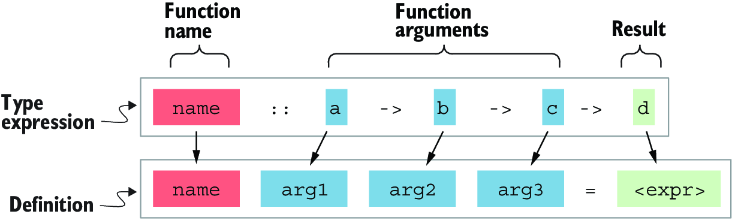
Compare a function type expression with its matching definition to see how input and result types correspond to parameters and the computed expression. section 2.2.3



















