An endpoint is an addressable device connected to a network that starts a communication or receives it as the final destination. It offers or uses a network service. A router, switch, or hub has a different primary job: helping communications travel between devices. section 11.3.1
Think of a network as roads carrying messages between homes and workplaces. Endpoints are the places sending or receiving the messages; network links are the roads, while other network devices help move messages along. The devices use communication protocols—shared rules—to understand one another. section 11.3
Common endpoints include:
- Clients, such as laptops and smartphones, that request resources or services. section 11.3.1
- Servers that respond to requests, such as web servers delivering pages or file servers providing shared storage. section 11.3.1
- Network-connected sensors and actuators in Internet of Things (IoT) systems, which send measurements or receive commands. section 11.4.3
Each connected endpoint can also be an entry point for an attacker. More endpoints mean more potential entry points to protect. Endpoint protection brings together tools and practices to defend devices and sensitive information; its main tool categories include antivirus software, endpoint detection and response (EDR), and mobile device management (MDM). section 12.5.2
Figure 11.2 The main components of networks
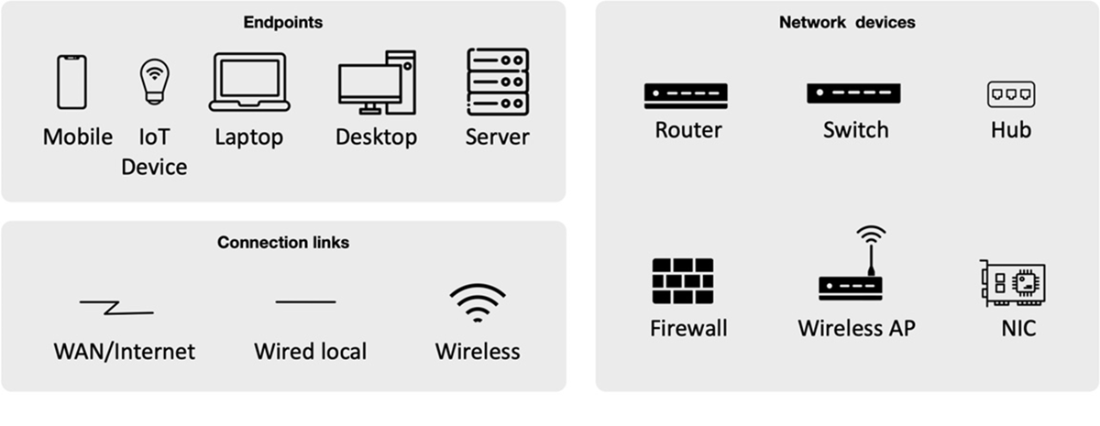
Use the network-components diagram to locate endpoints alongside the network devices and links that carry their communications. section 11.3