HTTP POST is a request method used most often to create a new server-side resource. A request starts with a method, URI, and HTTP version, followed by optional headers, a blank separator, and an optional message body. section 23.2.1
Use POST with these operational distinctions:
- Map POST generally to the Create operation in CRUD; treat the mapping as a convention rather than a universal rule because each API defines its methods. section 23.2.1 section 23.4
- Identify the target resource with the URI and specify the desired action with the HTTP method; include a message body when the request type requires submitted content. section 23.2.1
- Distinguish POST from GET, PUT, PATCH, and DELETE: retrieval uses GET, updates use PUT or PATCH, and deletion uses DELETE. section 23.2.1
Generating a Catalyst Center access token
In Postman, select POST, use the Catalyst Center token URI, choose Basic Auth, enter credentials, and send the request. A successful response returns 200 OK and a JSON-formatted token, which can be supplied in an X-Auth-Token header for a later GET request. section 23.3.3
Figure 23.3 The format of an HTTP request, consisting of a start line, headers, a blank line, and a message body. This message is an API call requesting to create a new ACL rule.
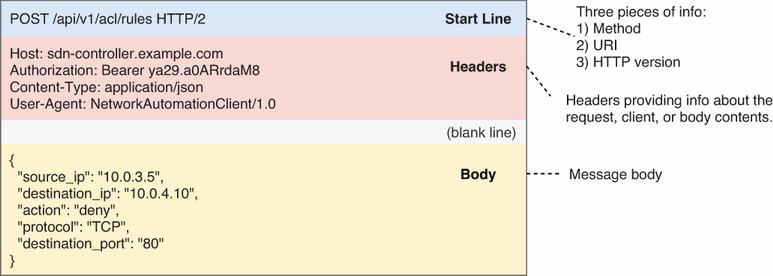
Inspect the request layout: start line, headers, blank line, and message body, illustrated by an API call creating an ACL rule. section 23.2.1













