HTTP POST submits data to a resource for processing. It most commonly creates a new resource, but it can also represent actions such as adding, starting, saving, or sending when another method does not fit. section 4.3.1
Creating a catalog product
Use POST /products to add a product and let the system generate its reference. The returned reference can then identify the product through GET /products/{Product reference}. This is usually preferable to PUT when identifiers are random, because consumer-provided IDs can collide. section 4.3.5
Map common collection and resource operations as follows:
- Create an element: POST /elements. section 4.3.6
- Add or create a customer: POST /customers; prefer meaningful paths over action paths such as /add-customer. section 9.3.1
- Treat POST as non-idempotent: replaying POST /transfers can create multiple transfers and repeatedly change server state. section 12.5.2
Figure 4.8 Refer to this mapping when in doubt about choosing an HTTP method for an action. CRUD stands for create, read, update, delete.
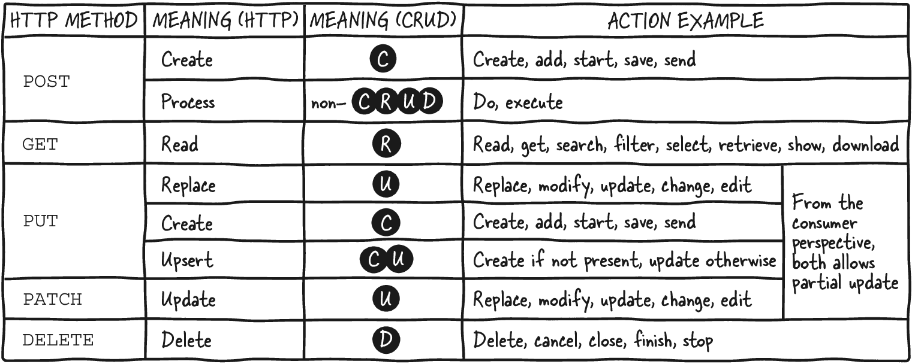
Use the CRUD-to-HTTP mapping when choosing POST, GET, PUT, PATCH, or DELETE for an operation. section 4.3.1













