A hybrid approach combines collaborative-filtering and content-based signals to retrieve or rank items. Agreement between signals can improve quality, while each method covers the other's weaknesses: behavior captures patterns metadata misses, and content supports new items. section 2.4 section 2.6
Implement a hybrid recommender by progressively combining signals:
- Retrieve candidates independently from each source, merge them, and combine their scores with explicit weights. section 3.6
- Boost items surfaced by multiple sources, since agreement increases confidence. section 3.6
- Adapt weights to item maturity: favor content for new items, then shift toward collaborative filtering as ratings accumulate. section 3.6
- Keep a popularity-based fallback for sparse metadata, missing behavior, model failures, or users without history. section 2.4 section 2.6
Popular for You
Start with popular items, then rerank them by user similarity. This simple hybrid combines broad popularity with personalized behavioral preference inside the same four-stage recommender pipeline. section 2.6
Figure 3.1 The four-stage recommender pipeline. Embeddings from this chapter feed into both the retrieval and scoring stages.
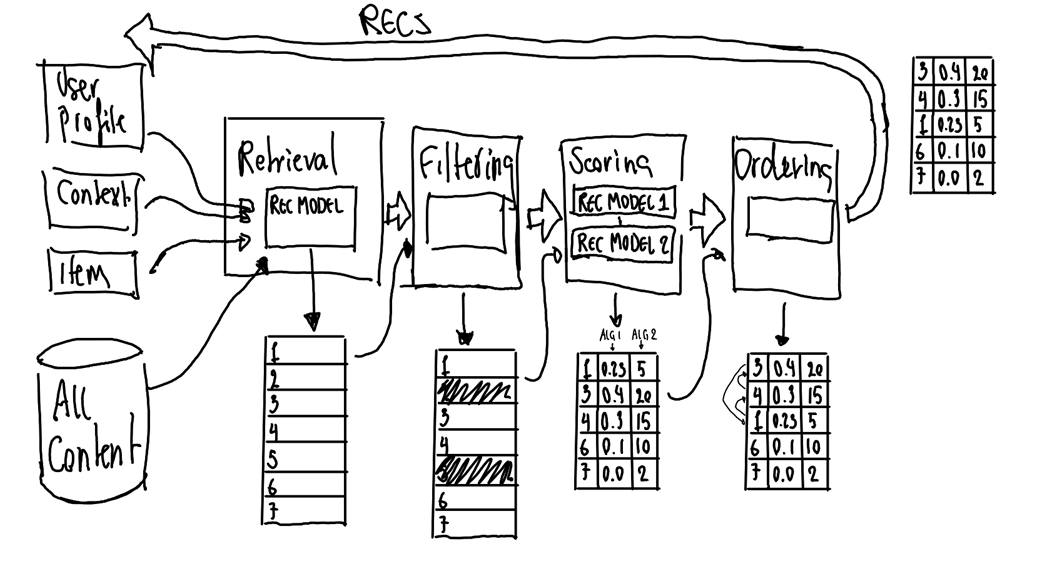
Use the four-stage pipeline to place hybrid signals in retrieval and scoring, then evaluate whether added sources justify their complexity. section 3.0