A hybrid approach combines rules, machine learning, and deep learning when fraud data mixes structured and unstructured elements. It suits semi-structured settings where tabular signals and text or images must inform detection together. section 1.5
Phishing detection
A phishing detector can combine structured signals such as IP address and receipt time with unstructured email body and header text. Rules may handle limited structured data, while machine learning or deep learning extends detection as data availability grows. section 1.5
Figure 1.16 Example of different data modalities hypothetically used (?) for a phishing fraud example. The Structured dataset contains only tabular data with decimal and binary numbers, the unstructured dataset contains natural text and images, and the semi-structured dataset contains elements of both the structured and unstructured dataset.
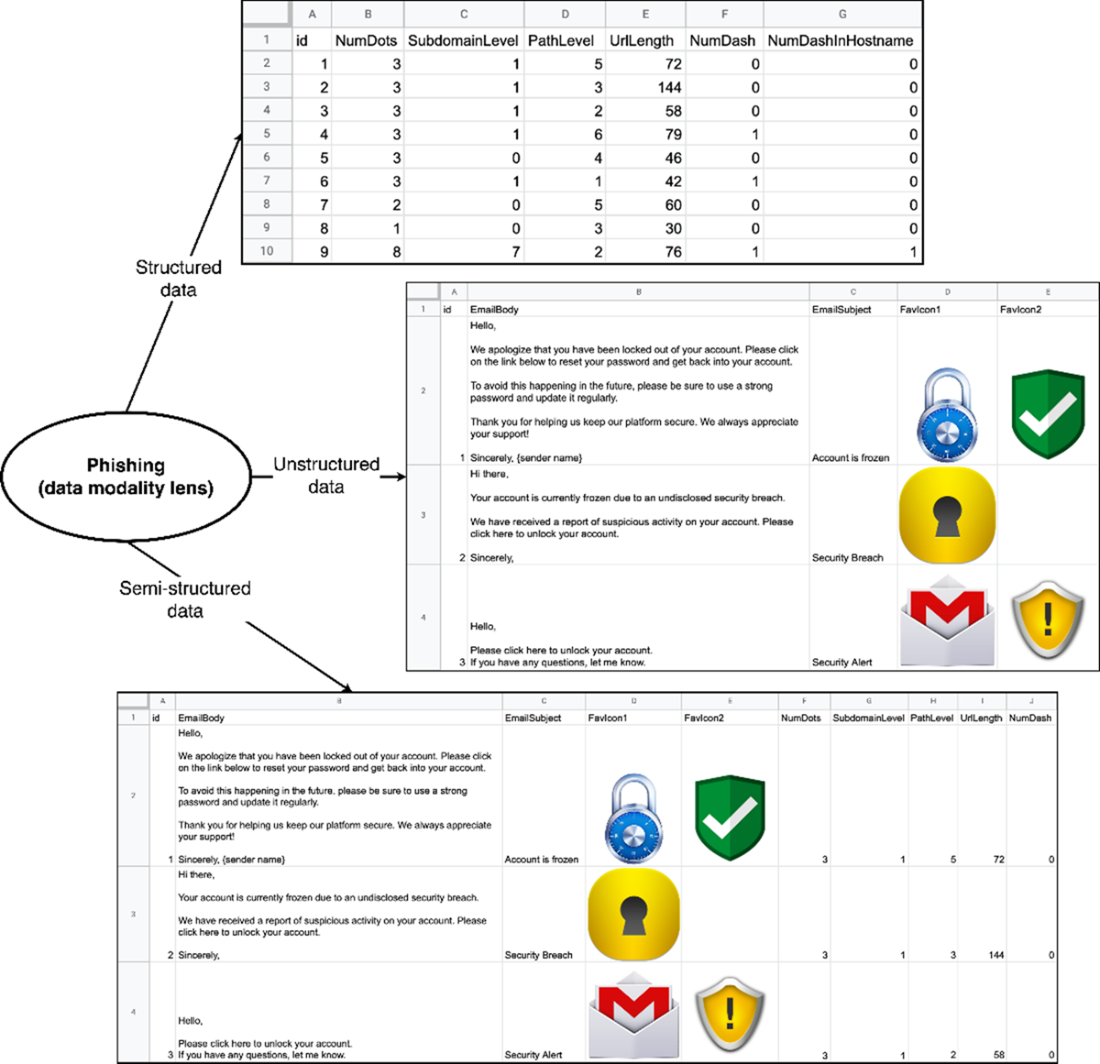
Compare tabular structured data, natural text and images, and mixed semi-structured data in a phishing-fraud setting. section 1.5