Incident response is the organized work of detecting a cybersecurity incident, limiting its damage, resolving its cause, and restoring operations. A tested incident response plan (IRP) gives the incident response team (IRT) procedures to follow when speed matters, while keeping critical business functions and assets in view. section 9.1 section 9.2
A practical response cycle connects preparation to action and improvement:
- Prepare: define the IRP’s scope around critical business functions, assign IRT roles across IT, legal, communications, and management, and train employees. section 9.2
- Identify and analyze: log the incident, assess what happened, and investigate its root cause so the team can choose an appropriate response. section 9.12
- Contain and eradicate: isolate affected systems to limit harm, gather evidence, and remove the cause while considering recurrence. section 9.1 section 9.12
- Recover and communicate: restore normal operations, update affected stakeholders on progress and business impact, and meet applicable notification requirements. section 9.10 section 9.6
- Review and rehearse: document lessons learned, update the IRP, and test it periodically with realistic tabletop scenarios. section 9.10 section 9.3
Measure the response, not just the number of alerts. Mean time to contain an incident (MTTC-I) shows how long containment takes after identification; mean time to remediate (MTTR-I) covers full remediation. Incident response success rate (IRSR-I) tracks the share successfully mitigated without further breaches. Compare these measures with targets and investigate bottlenecks before changing procedures or tools. section 9.9.1
Turning a delay into a decision
A cybersecurity firm averaged eight hours to contain an incident and 16 hours to restore operations. After refining its response strategies, average containment fell to three hours. The useful question for leadership is not simply whether the dashboard improved, but whether faster containment is limiting the downtime and potential data loss that prompted the changes. section 9.9.1
Figure 9.6 On the left side, CyberSecure Solutions’ incident response dashboard is shown before implementing incident response strategies and process improvements. The right side shows the incident response dashboard after the implementation of these strategies and improvements.
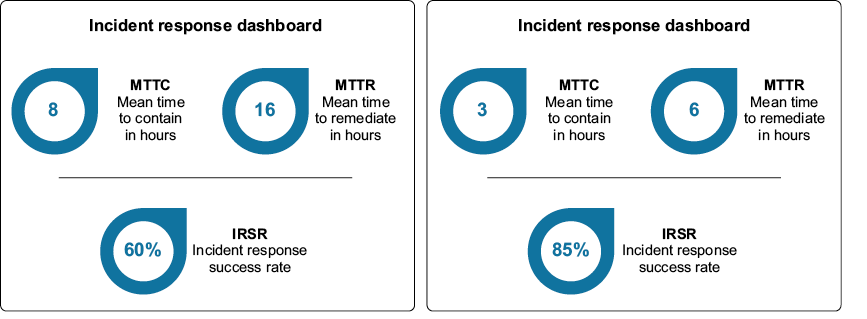
Compare the before-and-after response dashboard to see how process changes are evaluated against containment, recovery, and success measures. section 9.9.1
Automation can help detect suspicious activity and trigger containment, but it does not replace a coordinated plan. Set communication responsibilities and backup channels in advance; after recovery, use stakeholder feedback and documented lessons to improve the next response. section 9.1 section 9.11


