Inductive inference derives broader patterns, conclusions, or predictions from observed cases. Unlike memorization, it generalizes to unseen cases; unlike deduction, its conclusions can remain uncertain or false even when observations are correct. section 2.4 section 2.5.2
An inductive reasoning pipeline typically proceeds as follows:
- Transform raw observations into structured data, often using machine learning or natural language processing. section 2.5.2
- Store the resulting concepts, relationships, and observations in a knowledge base or knowledge graph. section 2.5.2 section 2.1
- Abstract patterns from available data to predict outcomes or generate actions, even when information is incomplete. section 2.5.2
Spam filtering
A filter that stores only previously labeled spam messages and matches new messages performs retrieval, not proper learning. An inductive filter generalizes from labeled examples to identify unseen spam messages. section 2.4
Inductive learning is especially useful when new data arrives. In graph learning, parametric mappings use node features to generate representations for unseen nodes, whereas shallow lookup-table embeddings remain tied to nodes observed during training. section 11.1.1 section 11.3.2
Figure 2.12 An inductive reasoner. Constructing the knowledge base requires more effort; it is not a simple transformation. This reasoning engine can abstract from the knowledge base and work under some level of uncertainty.
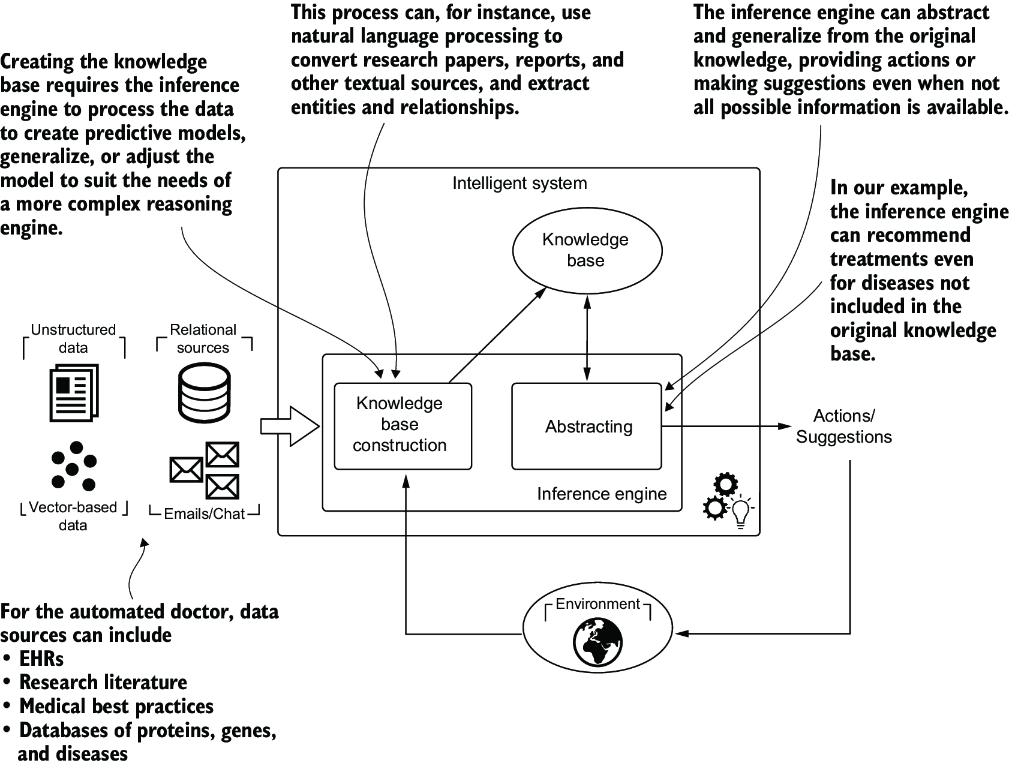
Use the inductive-reasoner diagram to trace structured-data construction, knowledge-base expansion, uncertain abstraction, and prediction or action. section 2.5.2


