Intelligence is the ability to use past experience and innate prior knowledge to handle novel, unexpected situations. It works by finding precedents, forming analogies, and applying abstract concepts rather than merely repeating learned responses. section 19.3.1 section 19.3
Making the unfamiliar recognizable
A person seeing a jet plane for the first time might call it a large, loud metal bird that does not flap its wings. A car becomes a horseless carriage; electricity becomes water flowing through a pipe. These analogies connect unfamiliar situations to reusable concepts. section 19.3.1
Figure 19.7 A kaleidoscope produces rich (yet repetitive) patterns from just a few beads of colored glass.

The kaleidoscope image represents intelligence as recombining a relatively small set of meaning-bearing abstractions into seemingly endless patterns. section 19.3.1
The kaleidoscope hypothesis treats novelty as patterned recombination: the world appears endlessly complex, yet its parts share similarities and structural relationships. Intelligence depends on recognizing and exploiting those relationships. section 19.3.1
A practical target for intelligent systems is broader adaptation rather than narrow task completion:
- Measure how many sufficiently unfamiliar tasks a system can handle from a fixed amount of experience and prior knowledge. section 19.3.4
- Test tasks that were not programmed or anticipated, preventing a system from succeeding through task-specific shortcuts. section 19.3.4
- Use ARC-AGI-style grid tasks, where examples demonstrate a transformation and the system constructs an output for a new input. section 19.3.4
Figure 19.9 An ARC-AGI task: the nature of the task is demonstrated by a couple of input-output pair examples. Provided with a new input, you must construct the corresponding output.
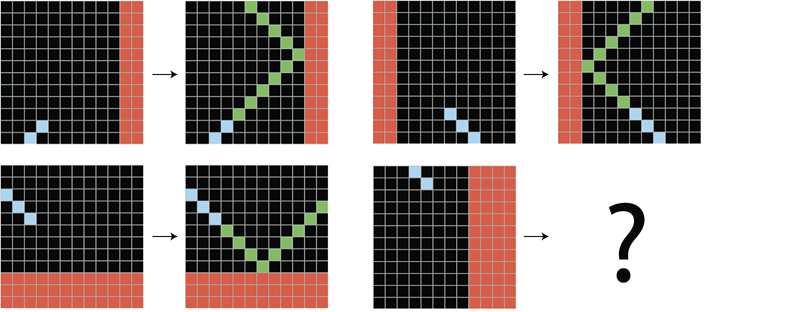
The ARC-AGI figure makes the adaptation test concrete: infer the rule from input-output examples, then apply it to an unseen input. section 19.3.4
Two proposed ingredients are abstraction acquisition and abstraction recombination. Their interaction determines which abstractions a system can manipulate and how effectively it can combine them; search and symbols are identified as possible complements to parametric abstractions learned through gradient descent. section 19.4





