Intelligence is the ability to use available information and past experience to produce successful behavior in an uncertain, changing future. Its purpose is not merely to repeat a learned response. It is to adapt when the next situation was not specified in advance. section 19.2.3
Making sense of something new
Imagine a person from the 17th century seeing a jet plane. They might call it a large, loud metal bird that does not flap its wings. The description is imperfect, but familiar ideas provide a starting point for understanding an unfamiliar object. The same move helps you navigate a new supermarket by relating it to stores you already know. section 19.3.1
This works because novelty often contains recognizable structure. The kaleidoscope hypothesis suggests that apparently endless variation can arise from recombinations of a relatively small set of recurring elements. Intelligence depends on finding useful abstractions in experience and putting them together in new ways—not on having seen every possible situation before. section 19.3.1 section 19.3.2
Two abilities make that adaptation possible:
- Abstraction acquisition: extract compact, reusable structures or principles from limited experience. section 19.3.2
- On-the-fly recombination: select and combine those abstractions to model a new problem as it arises. section 19.3.2
Efficiency matters in both steps. An agent that needs enormous amounts of practice to learn a skill, or must enumerate every possible move to choose one, is using its experience less efficiently. Classic deep learning can acquire abstractions during training through gradient descent, but this account identifies limited test-time recombination and high data demands as obstacles to broader intelligence. Strong performance on a particular trained task is therefore not, by itself, evidence of general adaptability. section 19.3.2 section 19.3.4
Figure 19.9 An ARC-AGI task: the nature of the task is demonstrated by a couple of input–output pair examples. Provided with a new input, you must construct the corresponding output.
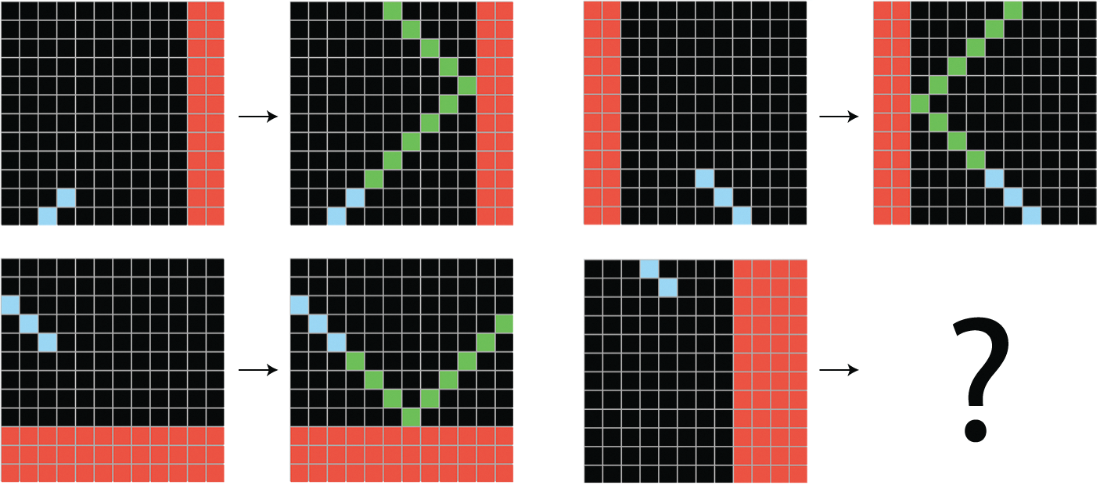
In an ARC-AGI task, a few input–output examples demonstrate a pattern; the challenge is to construct the output for a new input. It makes adaptation from limited information concrete. section 19.3.4
One proposed way to assess intelligence is to hold available experience and prior knowledge fixed, then test behavior on sufficiently different, unanticipated tasks. The question is how wide a range of new situations an agent can handle with what it was given. This is a more demanding target than checking whether it can perform a task it was trained or programmed to solve; it also calls for caution about claims that present AI has reached human-level general intelligence. section 19.3.4 section 1.10





