Intelligence is a broad, disputed capacity rather than a single measurable substance. IQ tests measure limited abilities, such as timed logic puzzles, but do not define intelligence; people can be book-smart without being street-smart. section 1.4
Artificial intelligence attempts to make rigid, rule-following computers perform tasks people handle without precise instructions, such as recognizing a cat in an arbitrary picture. For large language models, capabilities and reliability are more useful questions than whether the systems are truly intelligent. Their possible self-improvement also remains uncertain because intelligence is hard to quantify and computational limits persist. section 1.4 section 9.2.1 section 1.9
Figure 9.2 The S-curve, or sigmoid, shows the classic plateau behavior: at some point, you hit diminishing returns. The counterpoint to this expressed by the iterative S-curve model is that progress continues past the plateau of diminishing returns by discovering new techniques, each represented by a new S-curve. The new techniques may start worse than the existing methods but have a higher potential to surpass them.
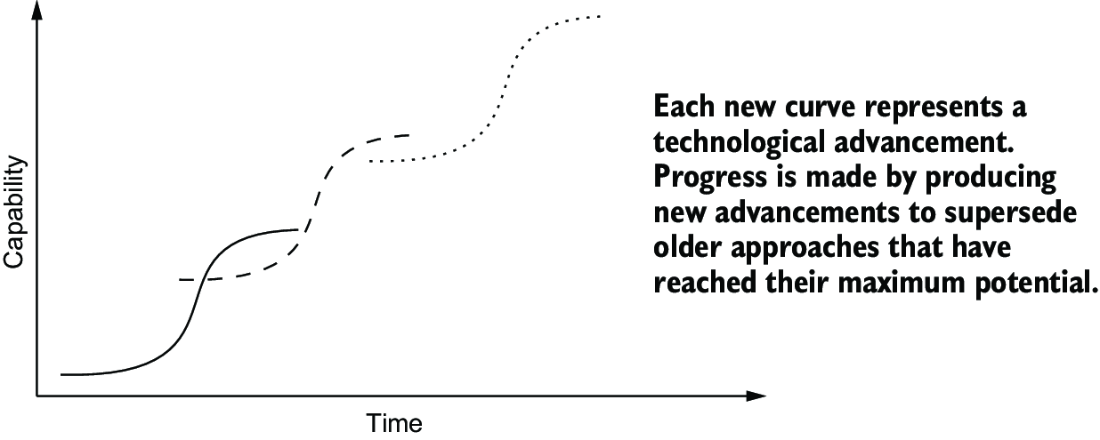
The iterative S-curve illustrates why improving intelligence may encounter diminishing returns while new techniques can begin further improvement. section 9.2.1





