Interpolation estimates values between known data points within the range represented by observed training data. In pharmaceutical machine learning, it supports predicting solubility or binding activity for molecules whose descriptor values resemble those already used for training. section 4.1.3 section 6.2.2
Use interpolation responsibly by:
- Representing molecules with descriptors such as molecular weight, hydrogen-bond donors, TPSA, logP, rings, and aromatic proportion. section 4.1.3
- Checking whether new descriptor values lie inside the training range; predictions outside it are extrapolations and may be less reliable. section 4.1.3
- Preserving the continuous variability of binding activity when splitting data, so models can interpolate across similar but nonidentical structures. section 6.2.2
- Using the Kennard–Stone algorithm to select diverse training samples that cover the dataset’s feature and response space. section 6.2.2
Figure 4.6 Estimated model AD based off of regions defined by the bounding box (dashed line) and convex hull (dotted line) methods.
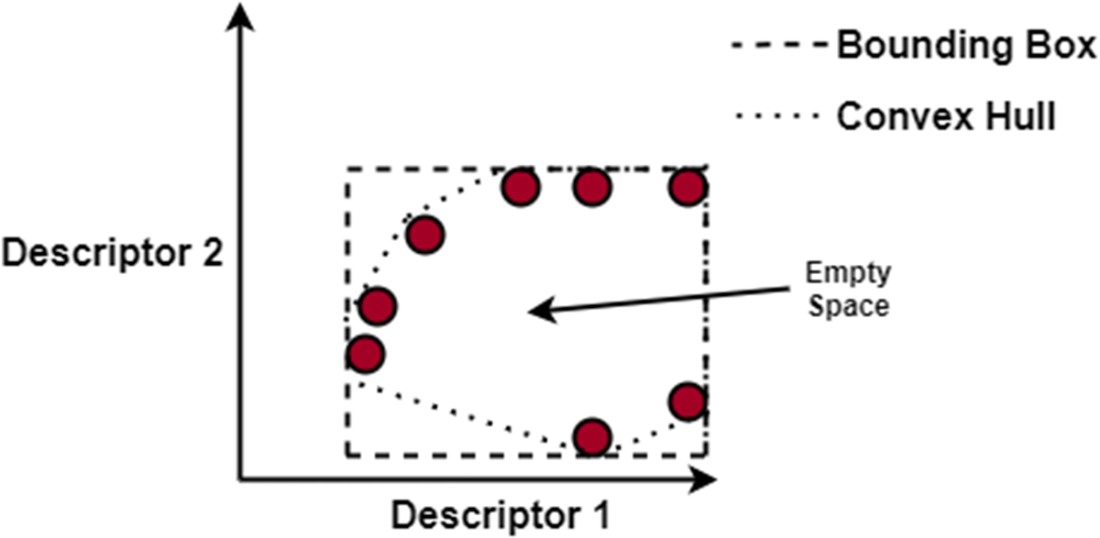
Compare bounding-box and convex-hull regions for judging whether descriptor combinations fall inside a model’s estimated applicability domain. section 4.1.3