liveBook · Manning

Inverse cumulative density function

As explained in Grokking Statistics

A percent-point function returns the value whose cumulative distribution up to that value equals a specified probability.

An inverse cumulative density function, also called a percent-point function, quantile function, or PPF, reverses a CDF lookup: give it an area from 0 to 1, and it returns the value with that area to its left. section 5.3

Finding the central 95% range

For a standard bell curve, the two tails outside the central .95 area contain .025 each. Use norm.ppf(.025, 0, 1) for the left boundary and norm.ppf(.975, 0, 1) for the right boundary. The result is approximately -1.959964 and 1.959964, written as ±1.959964. section 5.3

Figure 5.3 What range of Z-values (on the horizontal axis) will give me a center, symmetrical area of .95?
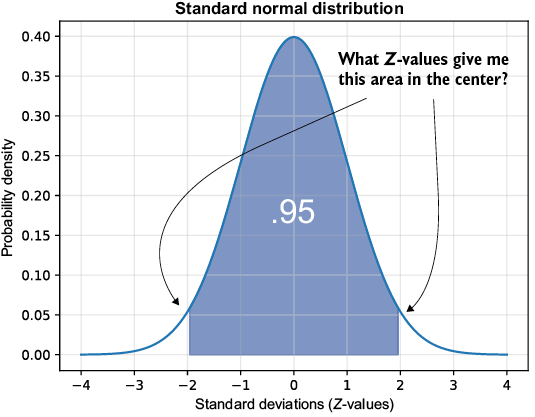
Visualizes how a symmetrical central area maps to its two Z-value boundaries. section 5.3

How Grokking Statistics covers it

How deep it goes
Explains the inverse lookup, tail-area arithmetic, symmetry, and SciPy implementation without deriving the distribution.
Examples
Uses .025 and .975 tail lookups to obtain the central 95% range, ±1.959964.
What it assumes
Assumes familiarity with cumulative distribution functions and probability areas while reinforcing their left-to-right interpretation.
What you can do after
Apply it via SciPy to calculate distribution values associated with specified cumulative probabilities.
How it connects
Connects cumulative distribution functions, quantile functions, normal distributions, bell curves, and critical Z-values.

Related concepts

This explainer was generated by Manning's knowledge graph from the text of Grokking Statistics. The section links point to the parts of the book it draws on.