A join combines records or documents by matching a shared identifier, attribute, or resolved entity. In a SQL database, the shared value is often an ID: a foreign key such as company_id links an employee row to a company row. The result is a composite record assembled from related data. section 2.1.2
Search systems can apply the same idea to unstructured documents. Two documents containing “Haystack” can be related through that shared term, much like rows joined on a common column. A fuzzy join goes further: different representations such as “Trey Grainger” and “Trey” may resolve to the same entity. Entity resolution supplies the meaning needed to join them, while ambiguous names can produce incorrect relationships. section 2.1.3
A practical join workflow makes the relationship explicit:
- Identify the linking value, such as an ID, foreign key, shared term, or entity representation. section 2.1.2 section 2.1.3
- Retrieve each side separately when the data lives in different tables, collections, or document sets. section 14.2.1
- Match the retrieved values and retain the fields needed for the composite record, such as a question, answer context, and URL. section 14.2.1
- Check ambiguous matches before using the resulting relationships in search or training data. section 2.1.3
Joining questions to accepted answers
A question-answering dataset can first retrieve community questions whose accepted_answer_id exists, then collect the accepted answers in batches. Mapping answer IDs to answer bodies produces rows containing the question and its answer context; those rows become training or evaluation data. section 14.2.1
Figure 2.3 Structured data in a typical database. Discrete values represent identifiers and enumerated values, continuous values represent data that falls within ranges, and foreign keys exist when the same value exists across two tables and can thus be used as a shared attribute that creates a relationship between corresponding rows from each table.
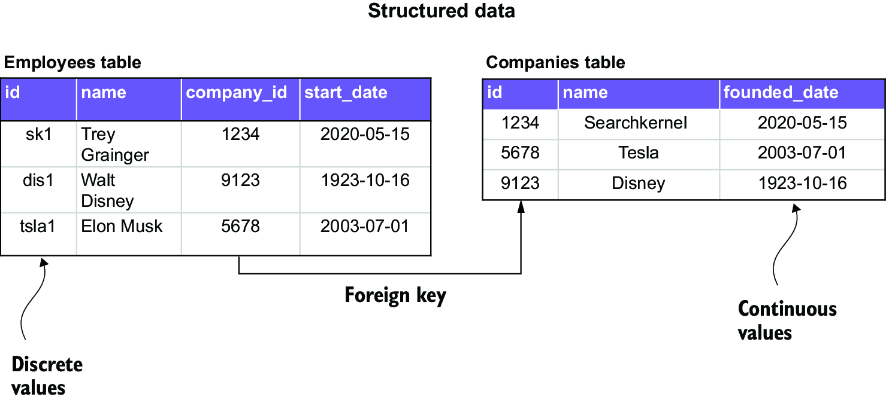
Use the figure to inspect how discrete identifiers, continuous values, and foreign keys create relationships between structured records. section 2.1.2
Figure 2.5 Fuzzy foreign keys. In this example, the same entity is being referenced using different terms, and a join is occurring based upon multiple phrases resolving to the same entity.
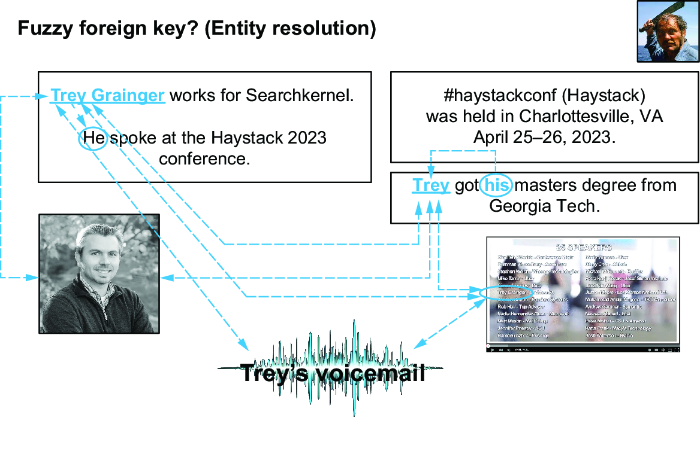
Use the figure to compare exact shared terms with fuzzy references in which different phrases resolve to one entity. section 2.1.3















