A JOIN combines rows from relational tables using their relationships or a matching condition. It lets a query fetch related data across multiple tables. section 8.2.1 section 6.8.3
Figure 8.2 Showing how Primary Keys and Foreign Keys work together to link tables. The child table (Orders) uses the Customer_ID as a Foreign Key to point directly back to its parent record (Customers), establishing a clear one-to-many relationship.
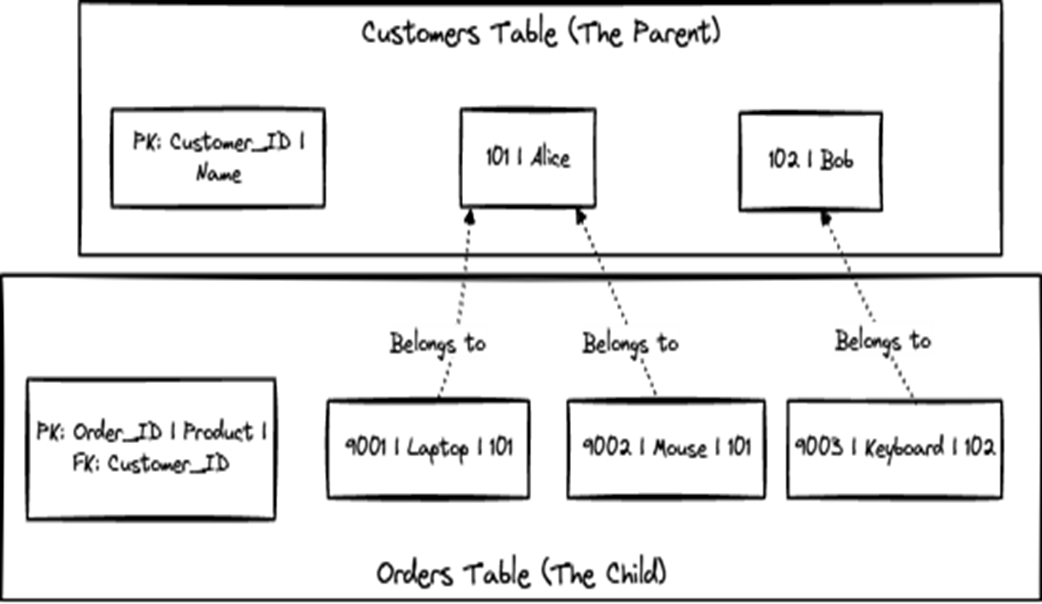
A primary key and a foreign key can establish the relationship used to link a parent record to its child rows. section 8.2.1
A cross-table request
A request for active orders placed by customers in Asia over the last 30 days, alongside their payment history, is an example of a complex multi-table query. section 8.2.1
Relational databases suit unpredictable queries and complex joins. But when related data is split across services and databases, a simple SQL JOIN is no longer available: an aggregator must collect the pieces through HTTP calls and handle failures. section 8.2.1 section 12.7.2