LangFlow is an open-source, low-code workspace for assembling language-model applications visually. Instead of starting with syntax, you place components on a canvas, configure them, and connect the flow of data between them. This makes experimentation and architectural reasoning accessible to beginners while giving Python developers a rapid prototyping path. section 1.1 section 2.2
A typical LangFlow workflow develops through these stages:
- Choose prebuilt components for inputs, models, prompts, tools, retrieval, or outputs. section 2.1
- Configure credentials and component settings, such as an API key and model choice. section 2.2
- Connect components into a visible flow and iterate by testing, adjusting, and experimenting. section 1.1
- Translate the visual design into Python when integrating a prototype into a larger application. section 2.4
A first chatbot
A simple Hello World application connects Chat Input to an OpenAI model and then to Chat Output, producing a working pirate-style chatbot. The same flow corresponds conceptually to a LangChain sequence of input, model call, and output, but LangFlow represents the chain by drawing it rather than writing it. section 2.0 section 2.4
Figure 2.3 Piecing bricks together to get a GenAI app
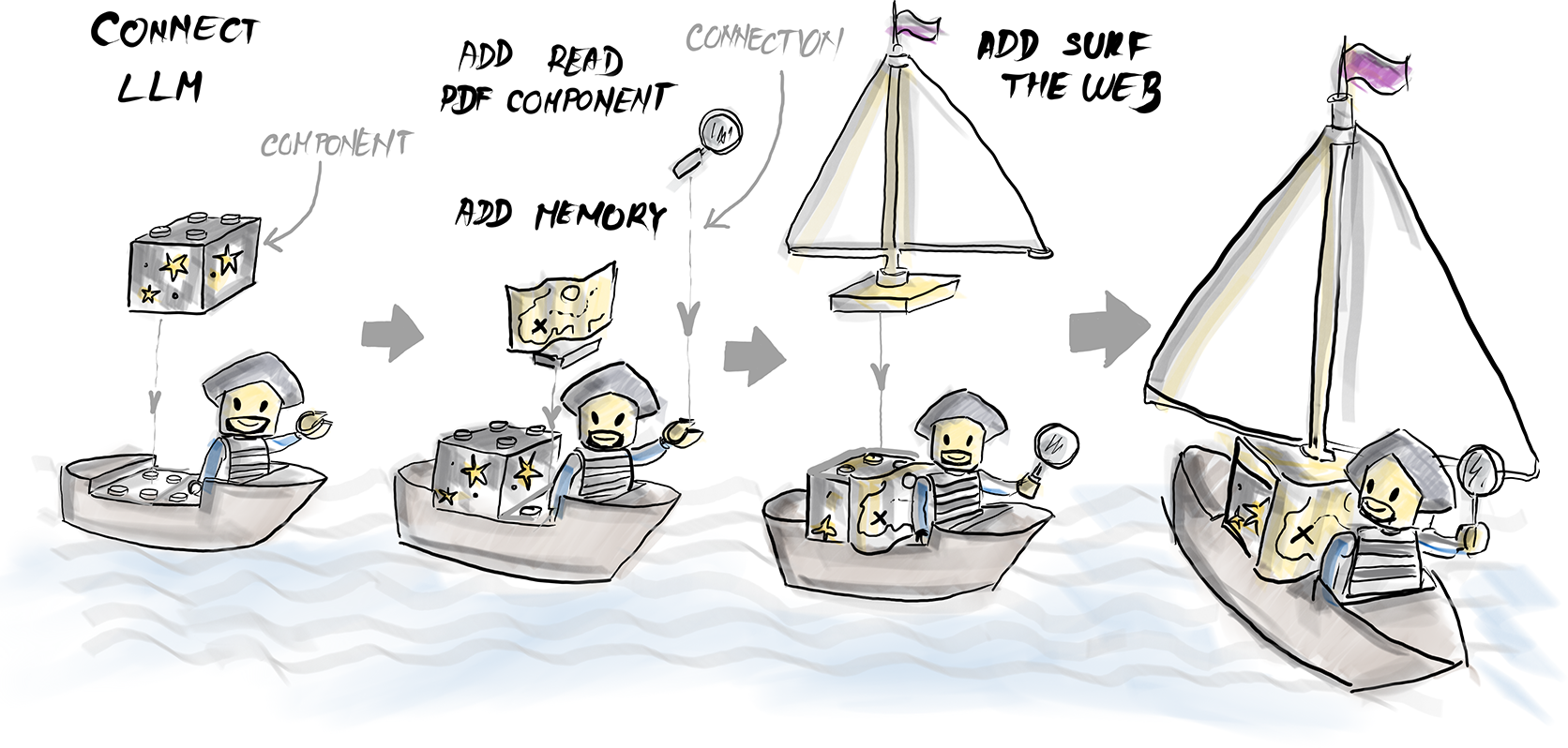
Use the visual brick metaphor to see how independently configured components become a connected GenAI application. section 2.2

