A neural network transforms its input layer by layer. Each layer applies a weighted sum with a bias, then a nonlinear activation such as ReLU. Early layers tend to capture simpler patterns; deeper layers combine them into more abstract representations. section 8.2
In deep reinforcement learning, hidden layers commonly use ReLU activations, while linear output layers represent Q-values. section 8.2
Figure 8.5 The building block of deep networks: neurons and activation functions
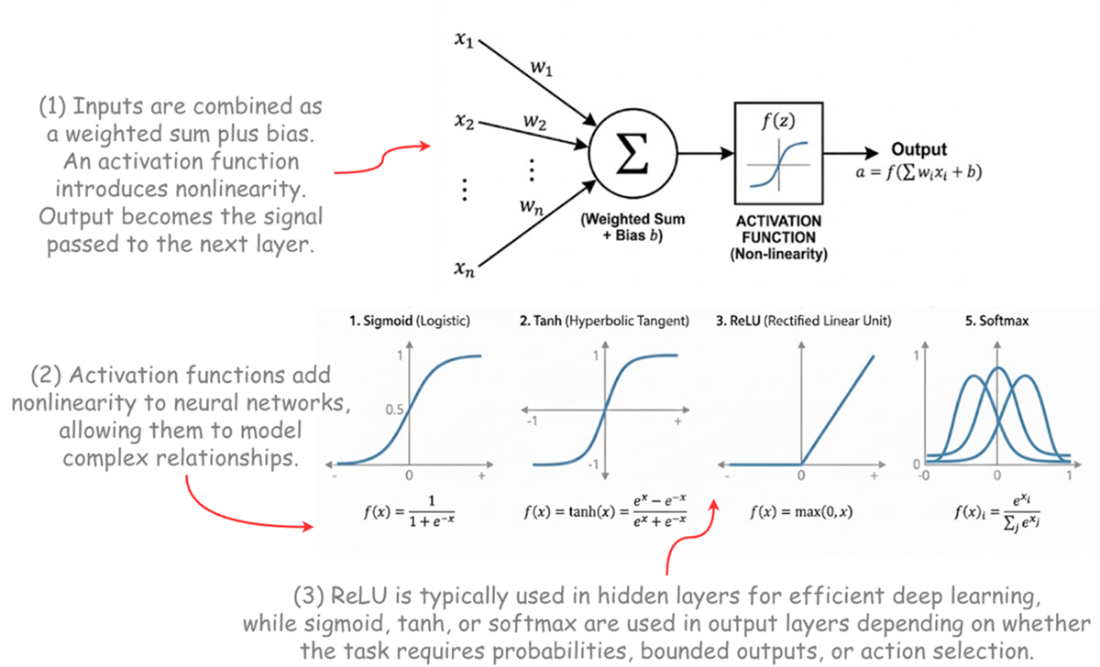
See how neurons and activation functions form the basic building blocks of deep networks. section 8.2











