A neural network layer groups nodes at the same stage between an input and an output. Layers organize how information moves through the network. section 10.8
Identify a layer by its role and structure:
- The input layer receives features, the output layer produces the result, and hidden layers sit between them. section 10.8
- The size of a layer counts its non-bias nodes; bias nodes belong to the architecture but are not counted. section 10.8
- In a fully connected architecture, every node connects to every non-bias node in the next layer, with no connections between nonconsecutive layers. section 10.8
- The number of layers excluding the input layer gives the network’s depth. section 10.8
A small layered network
Consider a network with an input layer of size 4, hidden layers of sizes 5 and 3, and an output layer of size 1. Its depth is 3 because the input layer is excluded from the count. As layers accumulate classifier boundaries, later layers can represent more complex boundaries than earlier ones. section 10.8
Figure 10.14 The general architecture of a neural network. The nodes are divided into layers, where the leftmost layer is the input layer, the rightmost layer is the output layer, and all the layers in between are hidden layers. All the nodes in a layer are connected to all the (non-bias) nodes in the next layer.
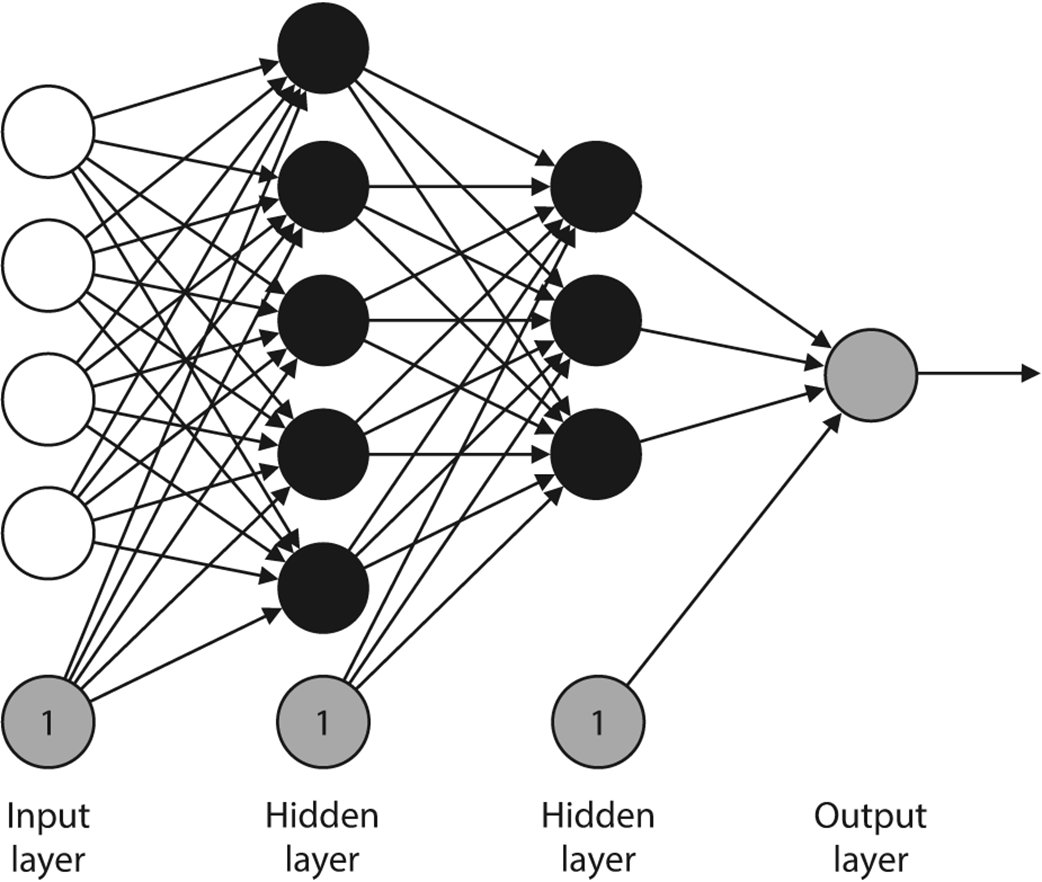
Use the architecture diagram to trace the input, hidden, and output layers and see how neighboring nodes connect. section 10.8











