A neural network layer groups computational units at one stage of a network. The units receive signals, process them in parallel, and produce signals for the next stage. Connecting layers lets a network transform information step by step rather than relying on a single modest transformation. section 3.1.2 section 3.1.6
The input layer receives data, and the output layer produces the result. Hidden layers lie between them: they are called hidden because they do not interact directly with the outside world. Their transformations reshape information so the network can produce a useful output. section 3.1.2
A shallow network may learn broad categories or simple distinctions. A deep network uses more hidden layers to build intermediate features: in an image, early transformations may respond to edges or strokes, while deeper ones combine those cues into shapes or objects. The depth needed depends on the problem. section 3.1.2 section 3.6
Figure 3.2 A deep neural network as a sequence of layers. The input layer receives raw data, the hidden layers transform it through learned representations, and the output layer produces the model’s prediction. In this example, the four input nodes might represent measurable features of an email, such as word frequencies or metadata, while the three output nodes might represent possible categories, such as personal, work-related, or spam. The network transforms these input features into output probabilities through the connections learned in the hidden layers.
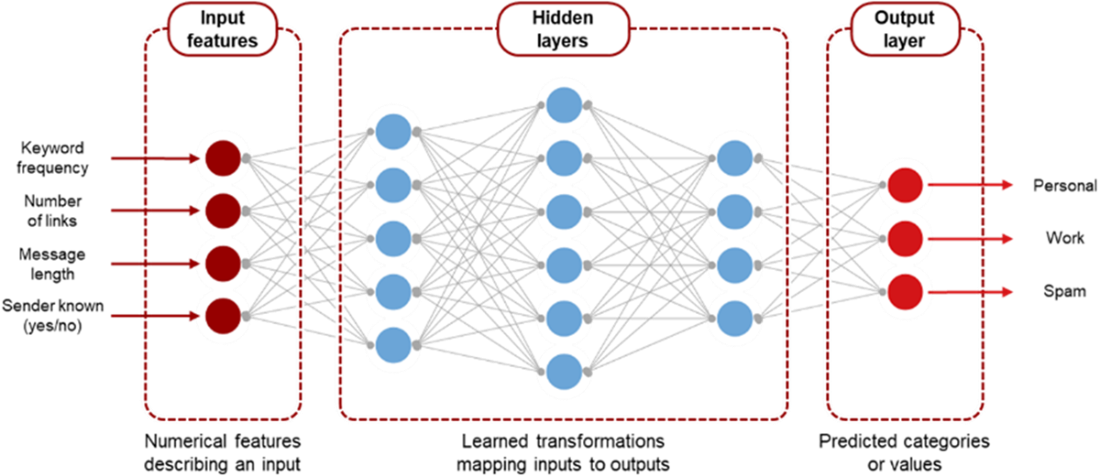
This diagram traces email features through hidden layers to output probabilities for possible categories. section 3.1.2
Depth and width affect capacity in different ways. Wider layers can represent more features at each step; deeper stacks can combine and transform features across successive steps. Greater capacity raises the complexity of patterns a model can potentially learn, but scale alone does not guarantee performance. section 4.2.1