liveBook · Manning

Constraint

As explained in Quantum Programming in Depth

A constraint is a condition that a candidate queen placement must satisfy, such as prohibiting two queens from sharing a row, column, or diagonal.

A constraint is a condition a candidate queen placement must satisfy. In the N-queens puzzle, no two queens may occupy the same row, column, or diagonal. With one bit per board cell, a reversible checking function must test every conflicting pair of cells and reject placements containing queens in both cells. section 8.1

Constraint checks can be organized as follows:

  • Enumerate cell pairs sharing a row, column, or diagonal. section 8.1
  • Require that no conflicting pair contains two queens. section 8.1
  • Estimate additional reversible-workspace bits at roughly one per checked constraint, while recognizing implementation-dependent variation. section 8.1
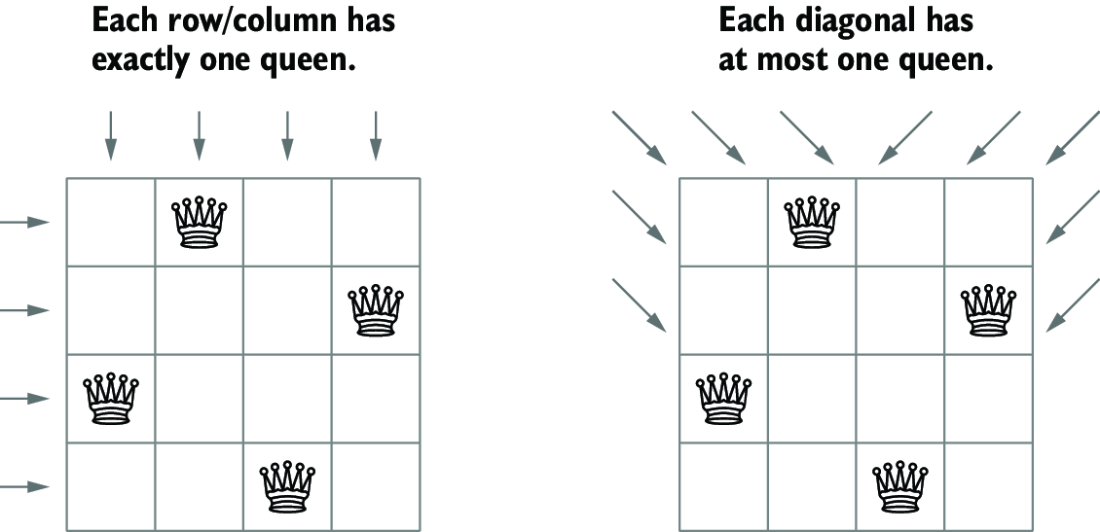
Figure 8.4 To improve on our naive solution, we can count the number of queens in each row and each column and check that there is exactly one. We can do the same for the diagonals, checking that the number of queens in each diagonal is zero or one.
figure

An alternative encoding counts queens in each row, column, and diagonal, requiring one per row and column and at most one per diagonal. section 8.1


How Quantum Programming in Depth covers it

How deep it goes
Derives pair counts and reversible workspace estimates, but stops short of a complete implementation.
Examples
Uses shared rows, columns, and diagonals as concrete conflict examples, with cell bits encoding occupancy.
What it assumes
Assumes familiarity with the N-queens puzzle and reversible computation, while refreshing the required pair-counting mathematics.
What you can do after
Evaluate candidate placements by enumerating conflicting cell pairs or counting queens along board lines.
How it connects
Connects N-queens, reversible computation, and Grover's algorithm through a constraint-checking function.

Also explained in

Compare how 19 books explain constraint →

Related concepts

This explainer was generated by Manning's knowledge graph from the text of Quantum Programming in Depth. The section links point to the parts of the book it draws on.
















