A cohort is a group of users considered together because they share an experimental assignment or other defining characteristic. Comparing outcomes across cohorts helps show how different experiences affect users. section 4.4 section 7.2
Cohorts can differ in the experience they receive:
- In a recommender test, groups receive recommendations from different models, and platforms compare metrics such as time spent. section 4.4
- In a voter-reminder study, one group saw friends’ photos with the reminder, another saw the reminder without them, and a control group saw no change. section 7.2
Figure 4.4 Randomized controlled trial in medicine: Patients are randomly split into two groups and, without their knowledge, assigned either the drug or the placebo. The effects on the population are later measured to understand the effects of the drug. In this example, we assume that a population has an ailment for which a new drug has been developed. The drug is given to a random subset of the population, and then the effects are compared with those who didn’t receive the drug. It is vital to do so to understand the baseline of remission. In this case, we can see how the drug is associated with doubling the number of people who are cured.
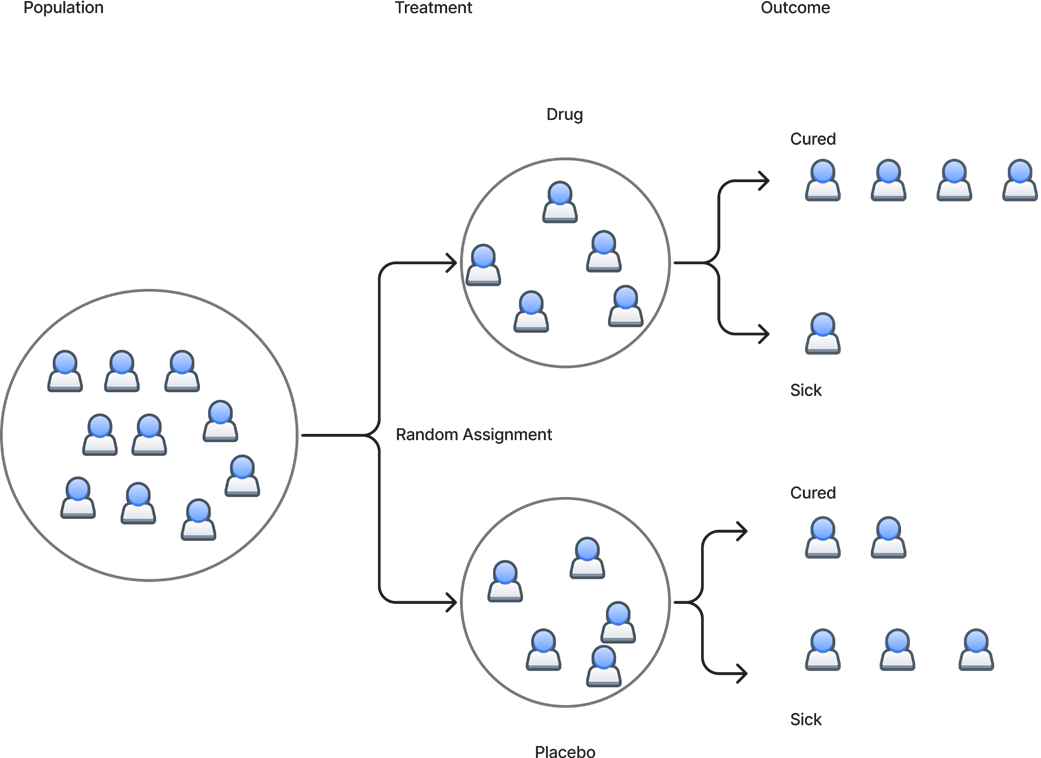
A medical trial offers a familiar analogy: compare outcomes for groups assigned different conditions. section 4.4


