A machine learning system combines data ingestion, model training, model serving, monitoring, and workflow coordination into an operational pipeline. It replaces laptop-scale experiments when datasets, incoming batches, model architectures, serving traffic, or end-to-end workflows exceed a single machine’s capacity. section 1.1.1 section 1.5
Design the system around the flow of data and computation:
- Ingest historical and frequently arriving data for downstream processing. section 1.1.1
- Train and evaluate models using distributed infrastructure when computation outgrows local resources. section 7.1.1
- Serve trained models under potentially heavy prediction traffic, using replicated servers when necessary. section 1.1.1 section 9.0
- Connect components with workflows that support parallel fan-out and fan-in, or asynchronous long-running steps. section 6.0
- Operate the pipeline through scheduling, metadata, observability, monitoring, deployment, and failure-handling practices. section 6.0
End-to-end image-classification system
Download Fashion-MNIST, process it with TensorFlow and Python, train and optimize an image-classification model with Kubeflow on Kubernetes, serve the final model, and compose the components with Argo Workflows. section 7.1.1 section 9.0
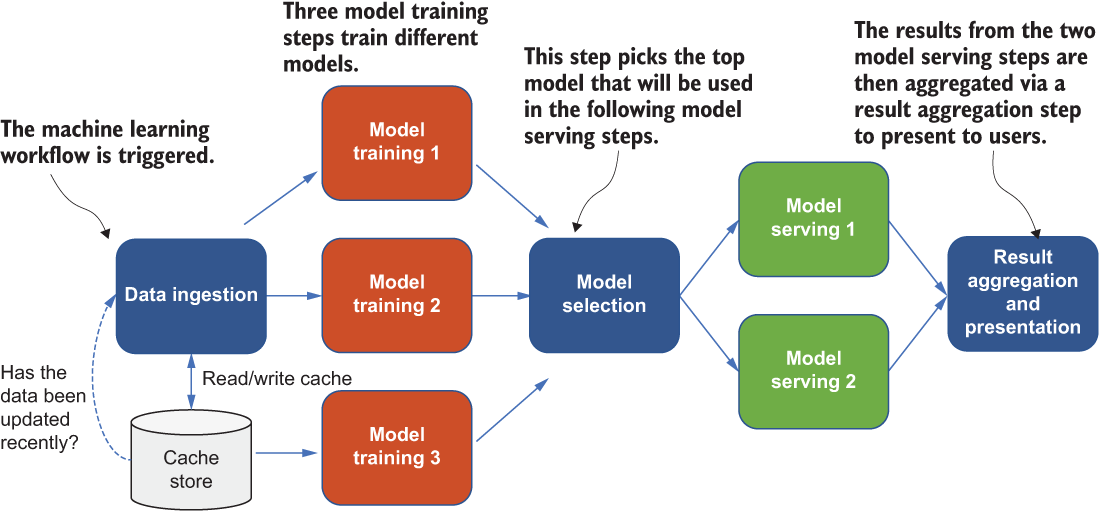
Use the architecture diagram to trace how ingestion, training, serving, and workflow components compose into one scalable end-to-end system. section 7.5



